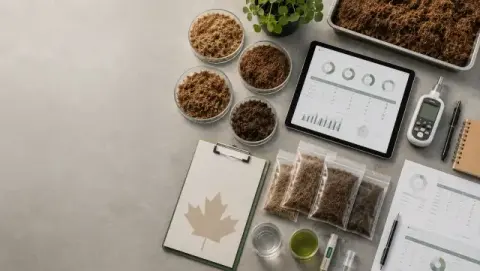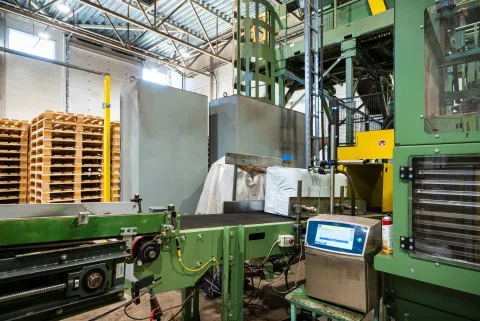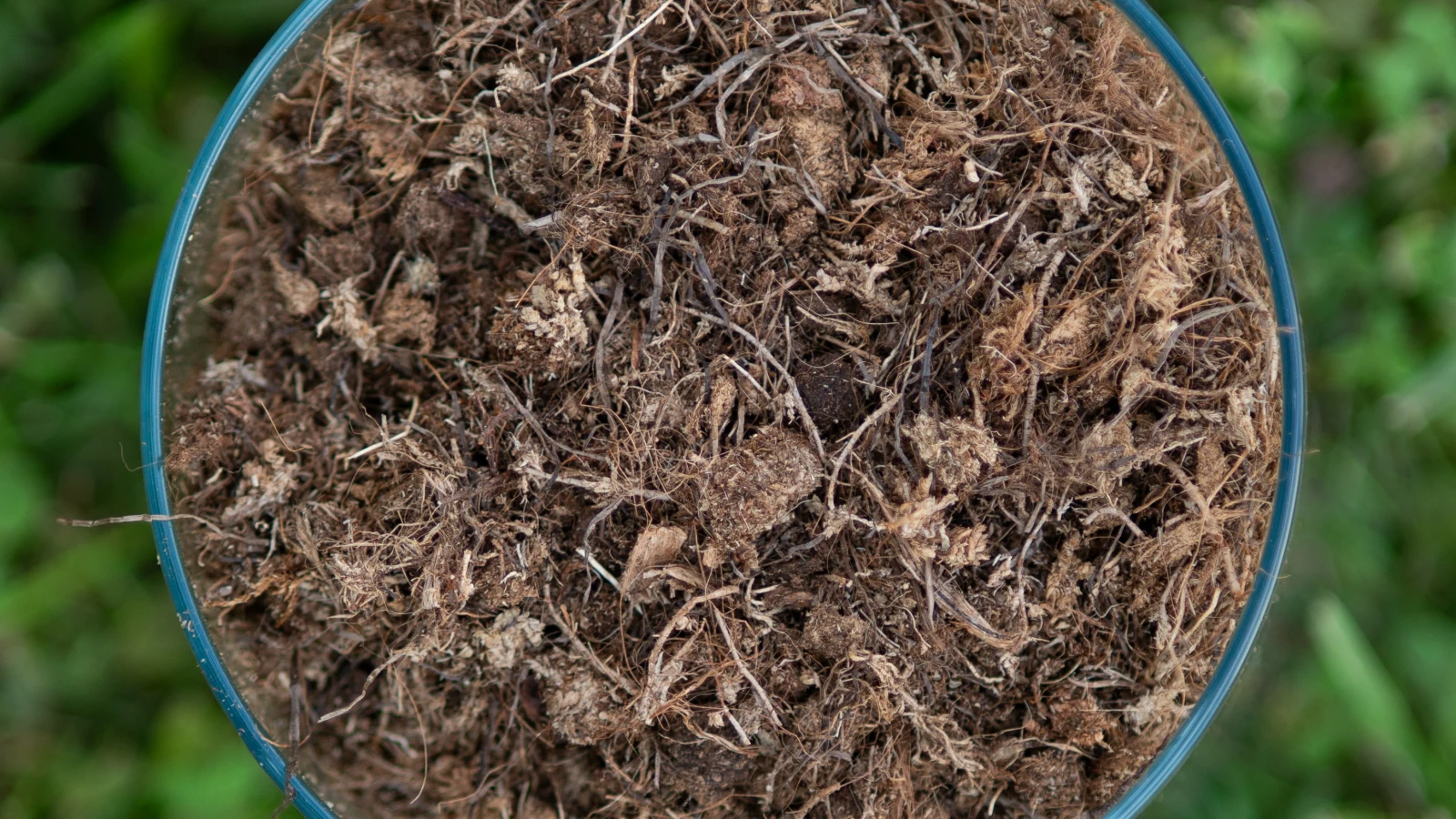
High-porosity growing media is formulated to keep a useful share of the root-zone pore system filled with air after irrigation and drainage. Its performance comes from the complete formulation together with the production container, filling density and irrigation programme, not from one ingredient percentage.
- High porosity describes the air-water balance in the complete root zone, not simply the amount of perlite or wood fiber in a recipe.
- Container height and filling density can change how the same growing medium drains and retains water.
- Irrigation must be evaluated together with the substrate structure and crop demand.
- For longer crop cycles, check whether the structure remains open after repeated irrigation, settling and root growth.
What does high porosity mean in growing media?
Porosity describes the part of a substrate volume that is made up of pores rather than solid particles. After the material is saturated and allowed to drain, some pores retain water while others contain air. Purdue Extension describes these properties as total porosity, container capacity or water space, and air space. Bulk density describes the dry mass of the substrate relative to its volume.
These measurements describe different parts of the same physical system. A medium can have a high total pore volume but still retain a large share of that volume as water. “High porosity” is most useful when the supplier and buyer are clear about the intended air-water balance after drainage, rather than treating the term as a general marketing label.
This also explains why a visible ingredient cannot prove performance on its own. Perlite or wood fiber can help create a more open structure, but particle-size distribution, peat structure, blend uniformity and compression during filling also affect the pore system.
Typical air space and water-holding values:
Purdue Extension gives an ideal air-space range of 20-25% of container volume for proper root growth. The same publication does not give universal target ranges for total porosity or container capacity. Instead, it reports two example substrates, which are useful references but should not be treated as specifications for every crop or container.
| Physical property | Purdue Extension reference | How to use it |
|---|---|---|
| Total porosity | 59.1% and 61.4% in two example soilless substrates | Example measurements, not a universal target range |
| Air space | Ideally 20-25% of container volume | General root-growth reference; container height changes the measured result |
| Water space | 72% and 62% of total pore space in the same two examples | Example distribution within pore space, not a universal container-capacity target |
The values and their measurement basis come from Purdue Extension's Understanding the Pores of a Soilless Substrate. Air space and water retention still need to be interpreted for the actual container height and production system.
How to measure air space in your own container:
The following pot method follows the practical procedure described by Purdue Extension. Use the same volume unit for the container and all water measurements.
- 1Determine the internal volume of the production pot. Use the manufacturer's stated volume or measure it accurately.
- 2Seal the drainage holes from the outside with a watertight liner and tape so no water can escape during saturation.
- 3Fill the pot to the top using the same material preparation and compaction used in production. At this point, substrate volume equals pot volume.
- 4Add water slowly until the substrate is fully saturated and a shiny layer appears at the surface. Cover the pot for one hour, add more water if needed, and record the total water added. Total porosity (%) = total water added / container volume x 100.
- 5Open or puncture the liner at the drainage holes. Collect the drained water for 10-15 minutes and measure its volume.
- 6Calculate air space as: air space (%) = drained water volume / container volume x 100. Calculate container capacity as: (total water added - drained water volume) / container volume x 100. Total porosity should equal air space plus container capacity.
Why does the container change the result?
The drainage holes are sealed only during saturation, while the total pore volume is measured. At that stage, all added water remains in the pot and fills the pore system. The geometry effect appears in step 5, after the liner is opened and the pot is allowed to drain.
Gravity removes water from the larger pores, but capillary forces retain water in smaller pores and in a perched-water zone at the bottom of the container. With the same substrate, this wet zone occupies a larger proportion of a shallow container than of a tall container. The taller container therefore has more air space and a lower proportion of retained water after drainage.
A mix that performs well in a tall nursery pot may therefore stay wetter in a shallow tray. A loose-filled container can also behave differently from the same container filled or pressed more densely. A laboratory value is useful only when its test conditions are understood.
How do peat structure, perlite and wood fiber shape the pore system?
Peat fraction and fiber structure form the base of the physical profile. Finer particles fit more closely together and are useful where uniform filling and close contact are important. Coarser particles create larger pore pathways and can help a mix retain its structure through a longer crop cycle.
Perlite introduces rigid, lightweight particles that can support drainage and air space. Wood fiber creates a different type of structure through elongated fibers and can help maintain openness within a peat blend. Neither component should be assessed separately from the peat base and the percentages used in the complete formula.
A grower choosing among a peat-perlite blend, a peat-perlite-wood-fiber blend and a peat-wood-fiber blend is not choosing three grades of the same product. These are different formulation approaches. The useful comparison is their behavior with the intended crop, pot and irrigation programme.
Why must irrigation be evaluated with the mix?
A more open root zone changes how water enters, drains and redistributes through a container. The appropriate irrigation response is not automatically “water more often”. Event volume, frequency, emitter uniformity, crop demand, climate and the container all matter.
During a trial, record how evenly the medium wets, how quickly drainage begins, how much water leaves the container and how the container weight changes between irrigations. Also check whether roots develop throughout the profile. These observations show the interaction between the formulation and irrigation more clearly than an ingredient percentage alone.
How can porosity change during the crop cycle?
Physical properties are not fixed for the entire production period. Purdue Extension notes that peat can expand and contract, organic components can decompose, root growth can occupy pore space and repeated overhead irrigation can compact the substrate. Handling and settling add further change.
A short initial wetting test cannot show these longer-term changes. For a long-cycle crop, structural stability after repeated irrigation and root development should form part of the final assessment.
What should buyers test before approving a high-porosity mix?
| Production variable | What it can change | What to check in the trial |
|---|---|---|
| Container height and shape | The balance between retained water and air after drainage | Use the intended tray, pot or grow bag rather than a substitute container. |
| Filling density | Compression can reduce larger pore spaces and alter drainage | Use the actual filling line and record filled container weight. |
| Irrigation event | Water distribution, drainage onset and leachate volume | Record applied water, drainage and container weight through the dry-down cycle. |
| Crop duration | Settling, decomposition and root occupation of pores | Run the trial long enough to represent the commercial crop cycle. |
| Peat fraction and added components | Pore size, structural stability and water movement | Compare complete formulations, not individual ingredient percentages. |
How do ASB high-porosity formulations compare?
ASB Professional supplies several North American high-porosity mixes. The verified catalogue data below shows three different composition approaches. Air-space, water-holding and fraction values are not listed because those figures are not available in the current product documentation.
| Product | Verified composition | Listed pH | Formulation direction |
|---|---|---|---|
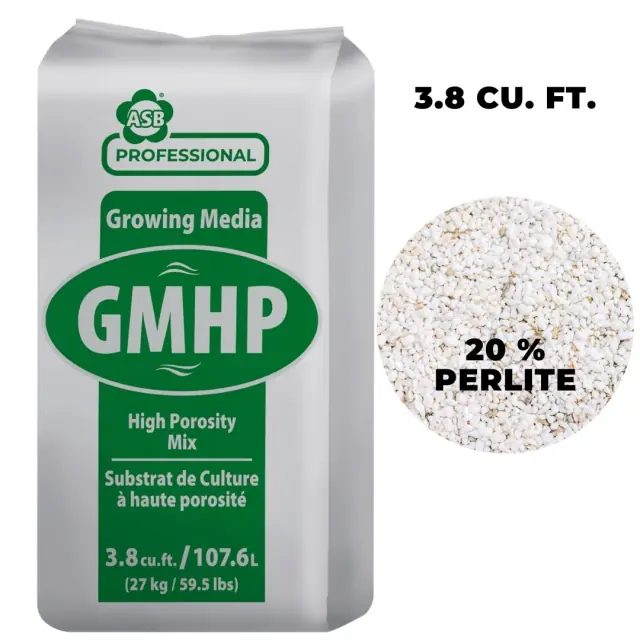
| ASB Grower Mix 20 | Peat moss + 20% perlite | Approx. 5.0-5.8 | Perlite-led option for a more open root-zone programme |
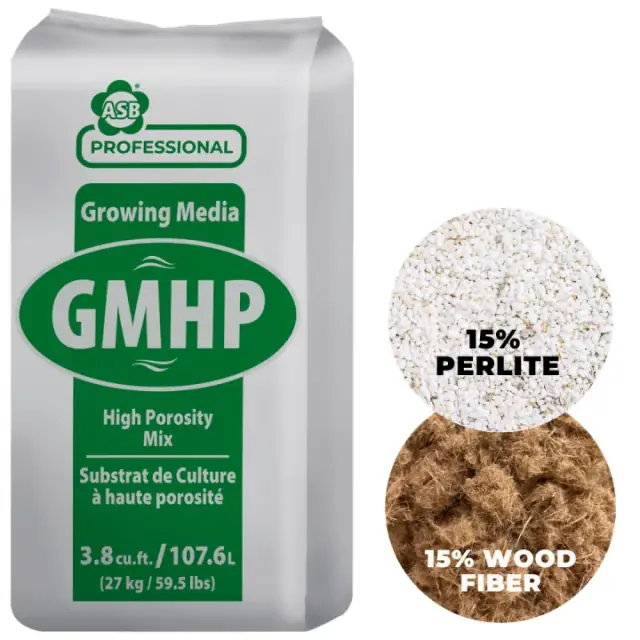
| ASB Grower Mix 15-15 | Peat moss + 15% perlite + 15% wood fiber | Approx. 5.0-5.9 | Combined perlite and wood-fiber structure |
| ASB Grower Mix 30 | Peat moss + 30% wood fiber | Approx. 5.0-5.9 | Wood-fiber-led structural option |
The table compares composition, not performance ranking. Crop, container, irrigation and the required pH and nutrient programme still determine which direction should enter a commercial trial.
A practical trial sequence
- 1Define the current problem. Record whether the concern is slow drainage, prolonged saturation, compaction, uneven wetting or root distribution. “More porosity” is too broad to be a useful trial objective.
- 2Keep the comparison controlled. Use the same crop, container, filling equipment, irrigation layout and environmental area for each candidate mix.
- 3Record the starting condition. Note filled container weight, filling consistency, first-wetting behavior and initial drainage.
- 4Follow the crop through representative irrigation cycles. Record applied water, leachate or drainage, container-weight change, visual root distribution and any wet or dry zones.
- 5Review structure at the end. Compare settling, compaction and root development through the full container profile before selecting the commercial formulation.
Illustrative example: a wet lower root zone
Consider a nursery crop in a 13 cm pot under drip irrigation where the lower part of the root zone remains wet between irrigation events. A sensible first trial would compare the current mix with a more open formulation while keeping the crop, pot, filling weight, irrigation layout and production area the same. Record water applied, drainage, container-weight change and root distribution before changing the full production programme. This is an illustrative decision process, not a product-performance guarantee.
For more detail on one common structural component, read Peat and Perlite Growing Media: When a More Open Root Zone Helps. Compare Peat Moss Fractions: 0-5 to 0-40 mm explains how particle range changes the starting structure. North American buyers can also compare the current ASB high-porosity growing media range.
The physical-property definitions and container-height principles in this guide are supported by Purdue Extension resources on the pores of a soilless substrate and evaluating container substrates and their components.
Recommended ASB products
These products are commonly evaluated with the strategy covered in this article.
FAQ
What is high-porosity growing media?
High-porosity growing media is formulated to maintain a useful share of air-filled pore space around roots after irrigation and drainage. Its performance depends on the complete particle structure, container, filling density and irrigation system, not only on the percentage of perlite or wood fiber.
Does high-porosity growing media always dry faster?
Not in every production system. Container height, crop water use, irrigation volume, filling density and environmental conditions all influence dry-down. The expected behavior should be checked in the intended container under the grower's actual irrigation programme.
Does more perlite always create more air space?
No single ingredient percentage guarantees the final air space. Perlite size and proportion matter, but so do peat fraction, wood fiber, blend uniformity, compression during filling and container geometry. Compare the complete formulation using the same test conditions.
Why can the same growing medium behave differently in different pots?
Container height changes drainage and the balance between retained water and air. A taller container generally drains more and retains a greater air-filled share than a shallow container filled with the same medium. Filling density and container shape can add further differences.
What air-filled porosity is good for nursery pots?
Purdue Extension gives 20-25% air space as an ideal general range for proper root growth. It is not a universal product specification: container height changes drainage and the measured air space, while crop duration, filling density and irrigation also affect the useful target. Compare values measured with the same method and in the intended production container.
Perlite or wood fiber: which is better for air space?
Neither component is universally better. Perlite adds rigid particles, while wood fiber creates an elongated fibrous structure; their effects depend on particle size, proportion, peat base and filling density. The decision should compare complete formulations and their stability through the intended crop cycle.
Comparing high-porosity mixes for a nursery programme?
Share the crop, container, crop duration, irrigation method and current root-zone problem so the ASB Professional team can identify suitable formulations for a controlled trial.
This article is part of the ASB Professional Blog and highlights topics across events, sustainability, and technical growing media expertise. ASB Greenworld Eesti is listed as a member of the Estonian Peat Association (Eesti Turbaliit).
It helps customers and partners follow company developments, market activity, and product-related topics.
ASB Professional Editorial Team