Two water sources can both read pH 7.5 and still affect a peat-based growing medium differently. If one has 40 mg/L alkalinity and the other 200 mg/L, the second source neutralises far more acid with every irrigation and can push root-zone pH upward over time.
- Water pH and alkalinity measure different things.
- High alkalinity can raise root-zone pH over time.
- Small containers and long crops are more sensitive.
- Test pH, alkalinity and EC before changing the programme.
pH and alkalinity measure different things
Water pH measures hydrogen-ion activity at the time of testing. Alkalinity measures the water's capacity to neutralise acid, mainly through dissolved bicarbonates, carbonates and, less commonly, hydroxides. Laboratory reports normally express total alkalinity as milligrams per litre or parts per million of calcium carbonate equivalent, written as mg/L CaCO3 or ppm CaCO3.
UMass Extension recommends testing both because pH does not reveal alkalinity. Water with a high pH can still have low alkalinity. Water with high alkalinity keeps adding bicarbonates and carbonates at every irrigation.
| Measurement | What it tells the grower | What it does not show |
|---|---|---|
| Water pH | How acidic or basic the sample is when measured | How much acid is needed to change it or its long-term effect on substrate pH |
| Total alkalinity | Acid-neutralising capacity, usually reported as mg/L CaCO3 | The complete water-quality picture or crop response |
| Water EC | The overall concentration of dissolved salts | Which ions are present or whether alkalinity is high |
| Substrate pH | Root-zone condition at the sampling time using the stated method | Which input caused the measured value or trend |
Why the effect builds up over time
A peat-based growing medium starts at a crop-specific pH, but that value changes during production. Irrigation water, fertilizer, lime reserve, crop uptake and leaching all affect the root zone.
Purdue Extension explains that high-alkalinity water is more likely to affect crops held in a greenhouse or nursery for months or years because the substrate's initial buffering is eventually overwhelmed by the accumulated carbonates and bicarbonates. It also notes that small containers have less substrate buffering capacity, so the same irrigation water can change their pH more quickly.
Repeated high-alkalinity irrigation can raise substrate pH and reduce the availability of micronutrients such as iron and manganese. Very low alkalinity offers little protection against acidifying fertilizer, so substrate pH can move downward more readily.
What alkalinity levels are considered acceptable?
Extension services use slightly different screening bands because crop groups, container systems and management assumptions differ.
| Source | Published reference | Practical interpretation |
|---|---|---|
| UMass Extension | 0-100 ppm CaCO3 described as desirable; 30-60 ppm considered optimum for most plants | A general greenhouse reference, not a crop-specific guarantee |
| Penn State Extension | Approximately 30-100 mg/L described as ideal; up to 150 mg/L may suit many plants; above 150 mg/L tends to be problematic | Values above the preferred range deserve closer crop and substrate monitoring |
| Purdue Extension | Below 80 mg/L classified as low, 100-200 mg/L as moderate and above 200 mg/L as high | A management classification that also considers crop duration and container size |
Treat these values as a first check. The useful range still depends on the crop, container, crop duration, fertilizer and target substrate pH. Acid-loving and iron-sensitive crops may need lower alkalinity.
Same pH, different outcome
| Water source | Water pH | Total alkalinity | Likely outcome |
|---|---|---|---|
| Source A | 7.5 | 40 mg/L CaCO3 | Little upward pH pressure |
| Source B | 7.5 | 200 mg/L CaCO3 | Substrate pH likely to rise |
The comparison shows why water pH by itself can lead to the wrong conclusion. Use the real laboratory report together with the crop, fertilizer, container, irrigation volume and substrate trend.
What a 52-week nursery study found
A peer-reviewed USDA-ARS study tested irrigation-water acidification at a commercial nursery in Florida with a history of high-alkalinity water problems. Thryallis plants were grown for 52 weeks under three treatments: 5, 3 and 1 meq/L alkalinity, produced by neutralising 0%, 40% or 80% of the calcium carbonate in the irrigation water.
At the end of the study, substrate pH measured by the 1:2 dilution method was 6.2, 5.2 and 4.7 respectively. The middle treatment produced more biomass and greener leaves. Visual quality was similar to the untreated water and clearly lower only in the most acidified treatment. Root development was better in the middle- and low-alkalinity treatments than in the untreated high-alkalinity treatment.
This was one crop at one nursery, so the values are not universal treatment targets. The useful finding is that alkalinity management changed substrate pH, nutrient status and plant performance over a full nursery production cycle. It also shows why maximum acid neutralisation is not automatically the best crop response.
How to read a water report
Check the units first. Irrigation water alkalinity reported as mg/L CaCO3 is numerically equivalent to ppm CaCO3 in dilute water. If the report lists bicarbonate as mg/L HCO3 instead, convert it before comparing the result with CaCO3-equivalent reference ranges.
Alkalinity as mg/L CaCO3 = bicarbonate as mg/L HCO3 x 50.05 / 61.02, or approximately x 0.82. Purdue also gives 1 meq/L as 50.05 mg/L CaCO3. For example, 244 mg/L bicarbonate is approximately 200 mg/L CaCO3.
Then read pH, total alkalinity and EC together. EC helps identify the overall dissolved-salt load, while the ion analysis shows whether calcium, magnesium, sodium, chloride or other constituents need attention. Hardness and alkalinity often occur together, but they are not the same measurement: hardness mainly reflects dissolved calcium and magnesium, while alkalinity describes acid-neutralising capacity.
The water source also matters. Well-water chemistry may be relatively stable, while pond or collected-water values can change with season, rainfall, biological activity or blending. Sample the water actually reaching the crop, not only the source before storage, treatment, fertilizer injection or mixing.
A North Estonia groundwater example
A published study of specific groundwater aquifer systems in North Estonia reported average bicarbonate concentrations of 154 mg/L in the north-central region, 164 mg/L in the northwest, 190 mg/L in the northeast and 176 mg/L at the Tallinn study site. Using the CaCO3-equivalent conversion above, those averages correspond to approximately 126-156 mg/L as CaCO3.
The same dataset also shows why a regional average cannot replace a water test. Individual bicarbonate results ranged from 42 to 366 mg/L across the reported North Estonia samples. The figures describe the aquifers and samples studied, not every well or irrigation source in Estonia. A grower should therefore test the water that actually reaches the crop before selecting treatment or adjusting a substrate programme.
A practical monitoring routine
- 1Send the irrigation water to a laboratory that reports agricultural or horticultural water quality. Request at least pH, total alkalinity and EC, plus the ion panel relevant to the crop and water source.
- 2Record where and when the sample was taken. Note whether it came from the well, storage tank, blended supply, injector outlet or emitter at crop level.
- 3Define the crop target and production system. Include species, container volume, crop duration, growing medium, starting pH, water volume and expected leaching.
- 4Add the fertilizer programme to the interpretation. Fertilizers can have an acidifying or basic reaction, so the same water can produce a different pH direction under a different feeding programme.
- 5Monitor substrate pH and EC with one stated method at consistent crop stages. A trend across several measurements is more useful than one isolated reading.
- 6If correction is needed, validate it on a controlled section before changing the whole crop. Recheck water after treatment and continue monitoring the substrate response.
Acid injection needs a proper calculation
The amount of acid needed is determined by alkalinity and the target residual alkalinity, not simply by the starting water pH. The calculation also changes with acid type and concentration, injector calibration, fertilizer interaction and flow rate. Concentrated acids create serious handling and equipment risks.
Use a qualified crop adviser or water-treatment specialist, appropriate safety controls and a calculation based on the current laboratory analysis. UMass notes that high-pH water with low alkalinity rarely needs acidifying, while high-alkalinity water may need treatment even when its pH looks moderate.
What this means when choosing growing media
Product-sheet pH sets a controlled starting point. Water and feeding determine how the root-zone pH changes during production, which is why ASB Professional matches the specification to the grower's water and crop programme.
When comparing growing media, share the complete water analysis with the supplier. It helps confirm the starting pH, lime and fertilizer direction, and the monitoring plan. Review the Worldwide potting mixes as possible formulation starting points, then ask the ASB Professional team to confirm the right specification against the crop and water report.
For the measurement context behind substrate pH and EC values, read Peat Moss pH and EC: What Commercial Buyers Should Ask For. For the physical interaction between water, drainage and container height, see High-Porosity Growing Media for Container Nurseries.
Sources used for this guide
- UMass Extension: Water Quality for Crop Production - Penn State Extension: Interpreting Irrigation Water Tests - Purdue Extension: Alkalinity Management in Soilless Substrates - USDA-ARS and HortScience: irrigation-water acidification in nursery crop production - Lithuanian Journal of Physics: groundwater chemistry in the northern Baltic region
Recommended ASB products
These products are commonly evaluated with the strategy covered in this article.

ASB Professional Substrate 0-25 WA
A 0-25 mm pH-adjusted mix with wetting agent for greenhouse and container programmes. Confirm the final specification against the crop and irrigation-water analysis.
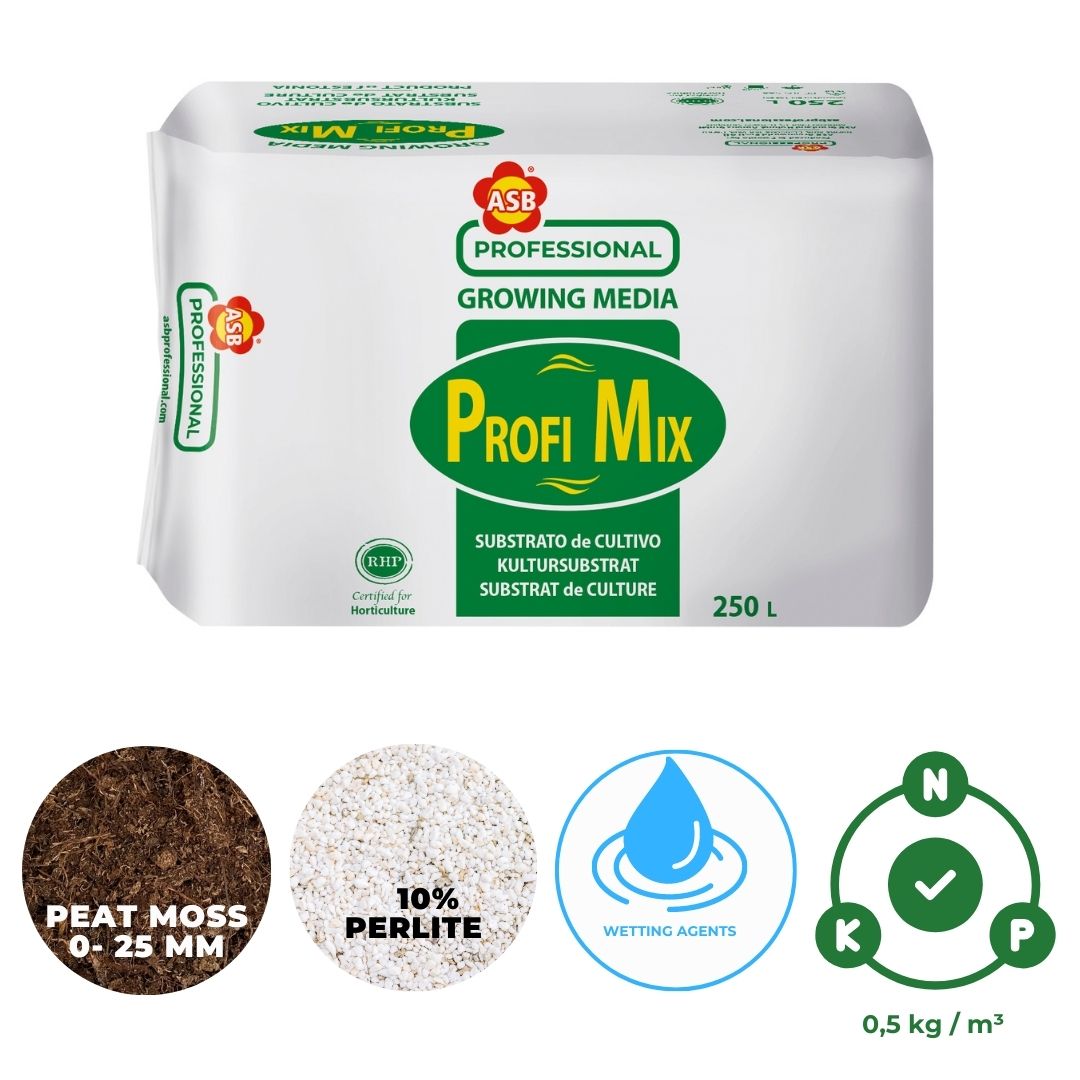
ASB Professional Substrate Mix 0-25 Perlite
A 0-25 mm potting mix with perlite for greenhouse vegetables and crops that need a more open root zone. Water alkalinity still needs separate management.
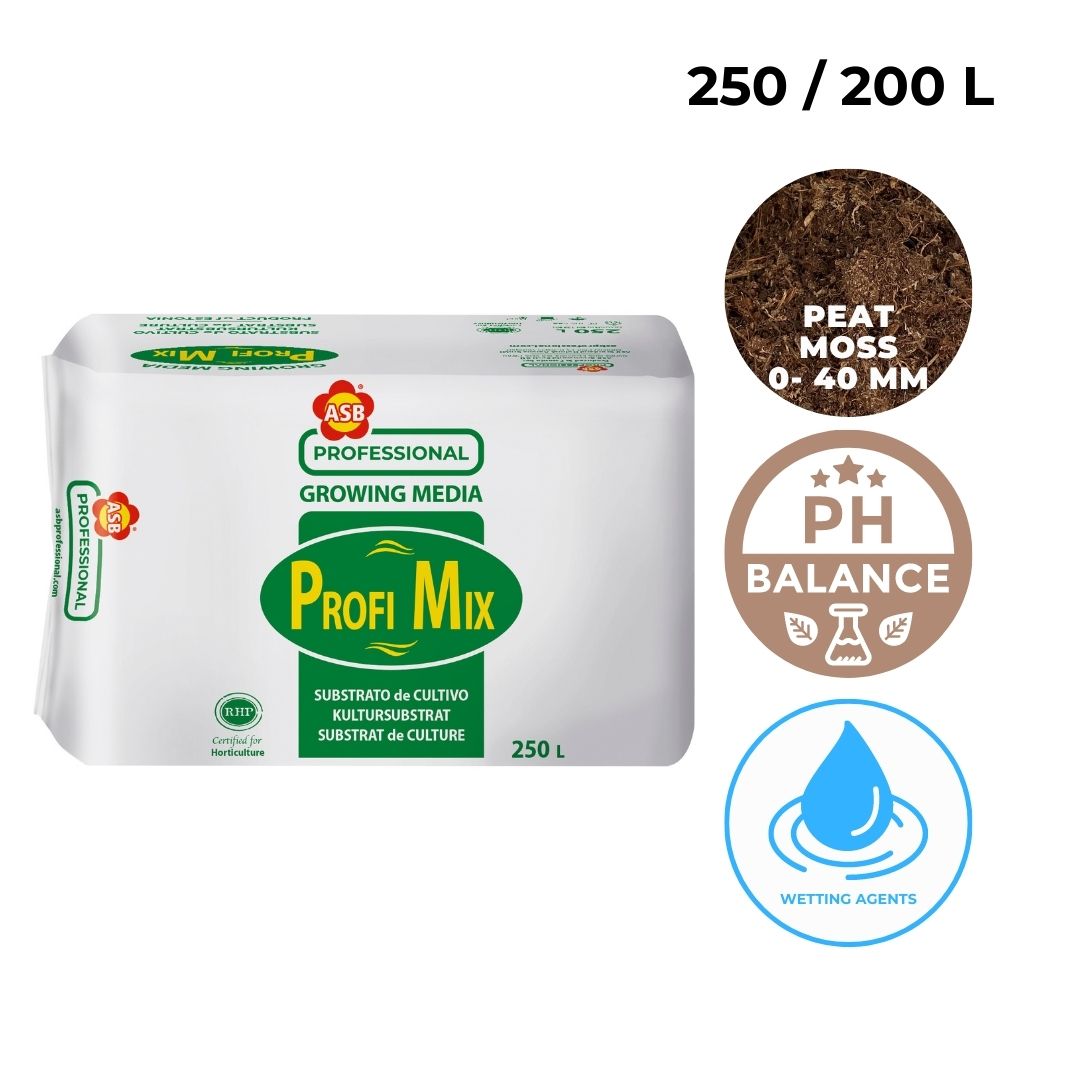
ASB Professional Substrate 0-40 WA
A coarser 0-40 mm option with wetting agent for larger containers and longer crop cycles. Select it only after reviewing crop, container and water conditions together.
FAQ
Is irrigation water pH the same as alkalinity?
No. Water pH describes how acidic or basic the sample is when measured. Alkalinity describes its capacity to neutralise acid, mainly through bicarbonates and carbonates. Two water sources can have the same pH but very different alkalinity and therefore different effects on growing media pH over time.
Can high-alkalinity water raise growing media pH?
Yes. Repeated irrigation can add enough bicarbonate and carbonate to overcome the initial buffering of a soilless growing medium and push its pH upward. The effect is usually more important in long crop cycles and small substrate volumes.
What alkalinity is suitable for greenhouse irrigation water?
There is no single limit for every crop and system. UMass describes 0-100 ppm CaCO3 as desirable and 30-60 ppm as optimum for most plants, while Penn State gives approximately 30-100 mg/L as ideal and notes that values above 150 mg/L tend to be problematic. Use crop-specific advice and monitor the substrate response.
Does high water pH always require acid treatment?
No. High-pH water can have low alkalinity and little buffering capacity. Treatment decisions should be based on total alkalinity, target residual alkalinity, crop, fertilizer programme and repeated substrate results, not on water pH alone.
Why are small containers more sensitive to alkalinity?
A small container holds less growing medium and therefore has less buffering capacity. Repeated delivery of high-alkalinity water can change the root-zone pH faster than in a larger substrate volume under otherwise similar conditions.
What should a greenhouse water test include?
At minimum, request pH, total alkalinity and EC from a laboratory familiar with agricultural irrigation water. Add calcium, magnesium, sodium, chloride and other relevant ions according to the crop and source, and record where in the irrigation system the sample was taken.
Comparing growing media for a known water source?
Share the crop, container, crop duration, irrigation-water analysis, fertilizer programme and target pH so the technical discussion starts from the real production system.
ASB Professional Editorial Team