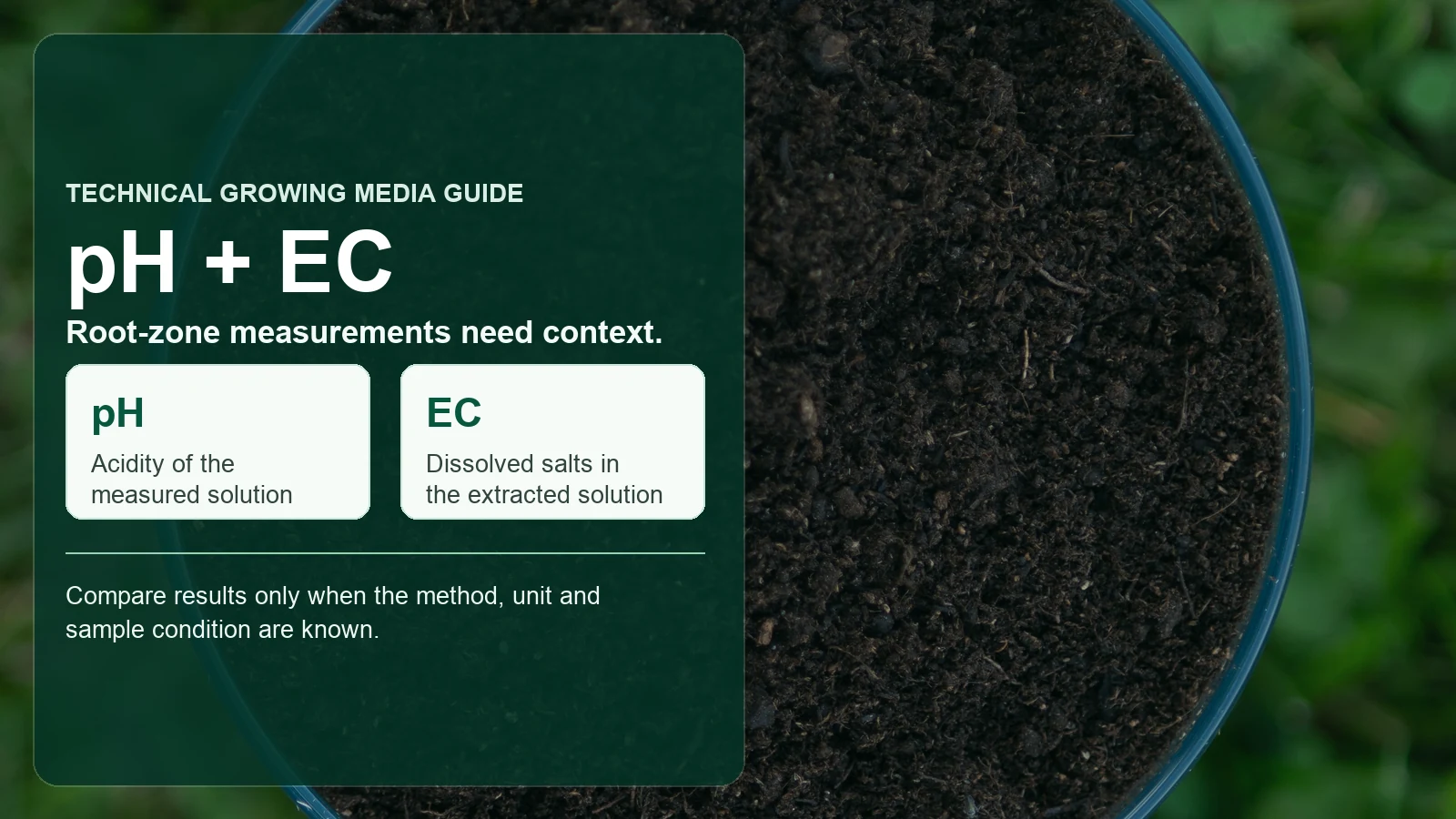
Peat moss pH and EC are not standalone quality scores. Commercial buyers should compare the measurement method, sample state, product formulation, water alkalinity, fertilizer programme and real crop trial before using the results in a purchasing decision.
- pH describes acidity in the measured substrate solution, while EC indicates the concentration of dissolved salts in that solution.
- A pH or EC value is only comparable when the extraction method, unit, sample condition and testing timing are also known.
- Raw peat moss and a finished peat-based growing medium should not be assessed by the same expectation because formulation, liming and nutrition can change the result.
- Irrigation-water alkalinity, not water pH alone, can materially influence substrate pH through a crop cycle.
- A useful commercial trial combines laboratory data with the actual crop, container, irrigation water, fertilizer programme and production period.
Peat moss pH and EC are often the first technical numbers a commercial buyer sees on a growing-media specification. They matter, but they are not standalone quality scores. A pH or EC result becomes useful only when the buyer also knows how the sample was tested, what the product contains, how it will be used, and what water and fertilizer programme will act on it after planting.
For procurement, growing and technical teams, the risk is simple: two product sheets can show similar-looking numbers while describing different extraction methods, different product types or different crop assumptions. Comparing the figures without that context can lead to the wrong conclusion before a trial even begins.
The useful procurement question is: “Are these results comparable, and do they fit our crop system?”
What pH tells a grower:
pH describes the acidity or basicity of the solution measured from a growing-medium sample. In commercial production, root-zone pH matters because it influences nutrient availability and interacts with the crop, fertilizer programme, irrigation water and the medium’s buffering behaviour.
A pH value should therefore be read as part of a production system. A raw peat material may be supplied as an acidic starting material for local blending. A finished peat-based growing medium may include pH adjustment and starter nutrition for a defined use. Those are different product levels, so they should not be evaluated against the same expectation.
Crop requirements also differ. Propagation trays, vegetable transplants, blueberries, nursery plants and longer-cycle container crops can require different root-zone targets and management decisions. Purdue Extension notes that many greenhouse crops are commonly managed within a substrate pH range of 5.4-6.6. That is a general educational reference, not an ASB product specification or a target for every crop; the crop programme and test method still need to be confirmed.
What EC tells a grower:
EC, or electrical conductivity, indicates the concentration of dissolved salts in the solution extracted from a growing-medium sample. In a finished medium, those salts can relate to starter fertilizer, the water used during production, added components and the crop-management programme. In a crop already under irrigation, EC also reflects what has accumulated or moved through the root zone.
EC does not identify every nutrient separately and it does not tell a buyer whether the crop will perform well by itself. A value may be appropriate, low or high only in relation to the crop stage, fertilizer programme, water quality, extraction method and the target management approach. A raw peat material and a finished fertilized mix should not be judged by the same EC expectation.
Why the measurement method belongs on the specification:
The method used to prepare the sample can change the reported pH and EC result. Commercial and university laboratories may use water (H2O) or sodium chloride (NaCl) as the extraction liquid, alongside different extraction ratios such as 1:5 or 1:1.5. They may also use saturated media extract, a dilution method, a leachate method or another agreed procedure. These methods extract the solution from the medium differently, so their results should not be treated as directly interchangeable.
The practical procurement rule is straightforward: request the agreed standard, extraction liquid, ratio, method, unit and sample condition next to every pH and EC result. When the same standard is used, the results are much more comparable. When a US or another different method is used, the values can vary materially even for similar material.
This is especially important when a buyer is comparing suppliers, reviewing a pre-shipment analysis or troubleshooting a nursery result. A number without its method, sample condition and unit is not enough evidence for a commercial decision.
A comparison example: two product sheets can both report pH 5.8, yet one may use a 1:2 dilution method while the other uses PourThru. The matching number does not establish that the two root-zone measurements or starting products are equivalent. First confirm the extraction method, unit, sample state and whether each sample is raw peat or a finished fertilized medium.
pH and EC are not the same as water pH and alkalinity:
A common mistake is to look only at the pH of irrigation water. Water pH and water alkalinity are related but different measurements. Alkalinity describes the water’s capacity to neutralize acids, and it can influence the pH of a substrate over time. A water source with high alkalinity can push substrate pH upward even if its pH alone does not appear unusual.
Purdue Extension notes that water alkalinity can have a much greater effect on substrate pH than water pH itself. Its alkalinity-management guidance is a useful reference for separating these two concepts. For a commercial grower, that means a water analysis should be part of the pH conversation before changing a substrate or fertilizer programme.
The interaction between product, water and fertilizer:
A finished growing medium begins with a stated formulation, but its root zone changes once the crop is in production. The irrigation-water source, fertilizer type, application rate, frequency, drainage, container volume and crop duration all influence the pH and EC that the grower observes later.
This is why a specification sheet and a crop-monitoring record serve different purposes. The product sheet describes the agreed starting product. The production record shows how that product behaves under the grower’s real conditions. Both are needed when a team evaluates a new medium or investigates a crop issue.
For a general framework on choosing between raw peat, a base composition and a finished growing medium, see Growing Medium for Professional Growers. White Peat vs Brown Peat vs Black Peat explains why material descriptions also need to be supported by fraction, physical data and the stated pH and EC method, and Compare Peat Moss Fractions compares the 0-5 to 0-40 mm range in detail.
Different product levels need different questions:
A substrate producer buying raw peat moss for a local recipe should ask for the relevant raw-material specification, including fraction, moisture condition, pH and EC method, packaging, consistency and delivery documentation. The buyer then remains responsible for the effects of local liming, fertilizer, wetting agents and other components added to the final composition.
A nursery or greenhouse buying a finished peat-based growing medium should ask a different set of questions. The crop, tray or container, expected production period, irrigation water, fertilizer programme, starting pH and EC method, product documentation and trial plan should be clear before a larger purchase commitment.
For crop-specific context, Substrate for Vegetables covers greenhouse and transplant production, while Substrate for Blueberries addresses acidic root-zone programmes. Both examples show why a crop system cannot be reduced to one laboratory number.
A practical pH and EC trial:
A useful trial begins by agreeing what will be measured and how. Use the actual crop, tray or container, filling method, irrigation-water source, fertilizer programme and production period. Agree whether samples will be sent to a laboratory, measured on site, or both. Keep the method consistent throughout the comparison.
During the trial, record the product batch, tray or container, date, crop stage, irrigation event, fertilizer input, pH, EC, root development, moisture behaviour, drainage and any management correction. The aim is not to create a laboratory exercise. It is to identify whether the root-zone data matches what the production team sees in filling, irrigation, crop uniformity and labour.
Use the same working sequence for every supplier comparison:
- Ask for the pH and EC method, unit, sample date and sample condition.
- Confirm whether the result describes raw peat, a base composition or a finished growing medium.
- Review irrigation-water alkalinity and the planned fertilizer programme before setting a target.
- Run the trial in the actual crop, tray or container with the intended filling and irrigation routine.
- Compare observations and laboratory results using the same sampling method before scaling the order.
Common mistakes to avoid:
One mistake is comparing pH or EC figures from different laboratories without confirming the extraction method. Another is treating raw peat and a finished fertilized mix as equivalent products. A third is reacting to a root-zone reading without checking irrigation-water alkalinity, fertilizer input or sampling location.
Sampling only the surface of a container can also misrepresent the active root zone. A consistent sampling plan should take material from the relevant root-zone area and use the same process each time. When the crop is sensitive or the order is large, a grower should involve an agronomist, laboratory or qualified technical adviser in the interpretation.
The practical takeaway:
Peat moss pH and EC should be treated as part of a documented technical conversation, not as isolated numbers on a product sheet. The strongest commercial decision connects the specified product, the agreed test method, irrigation-water alkalinity, fertilizer strategy and a realistic crop trial.
ASB Professional can help buyers structure that conversation for raw peat moss, seedling and propagation mixes, peat-based potting media and crop-specific growing programmes. Contact the international team with the crop, container, water analysis, fertilizer programme, expected volume and available product data.
Recommended ASB products
These products are commonly evaluated with the strategy covered in this article.
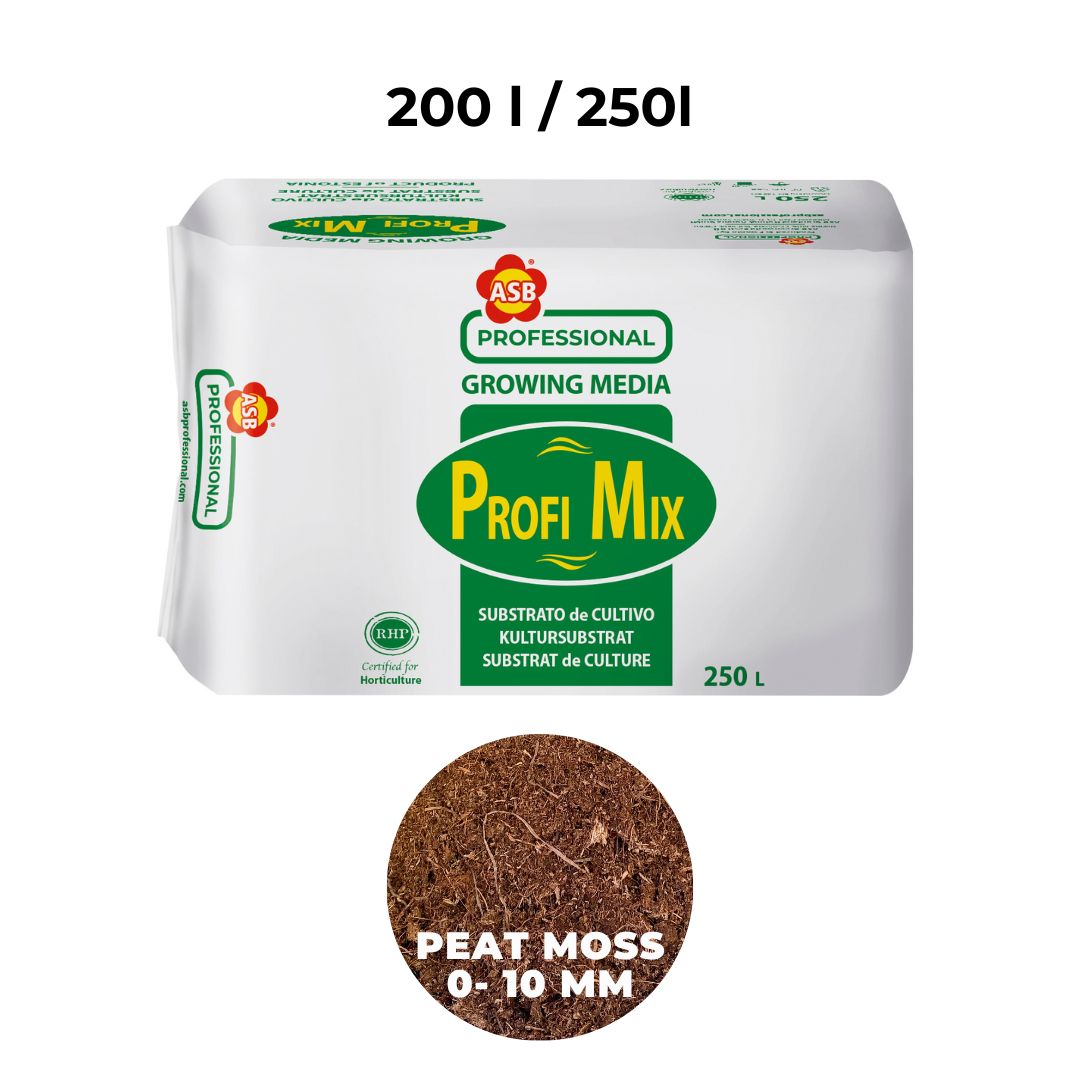
ASB Professional Substrate WP010
A starting material reference for buyers who need to separate raw-peat properties from a finished growing-medium specification.
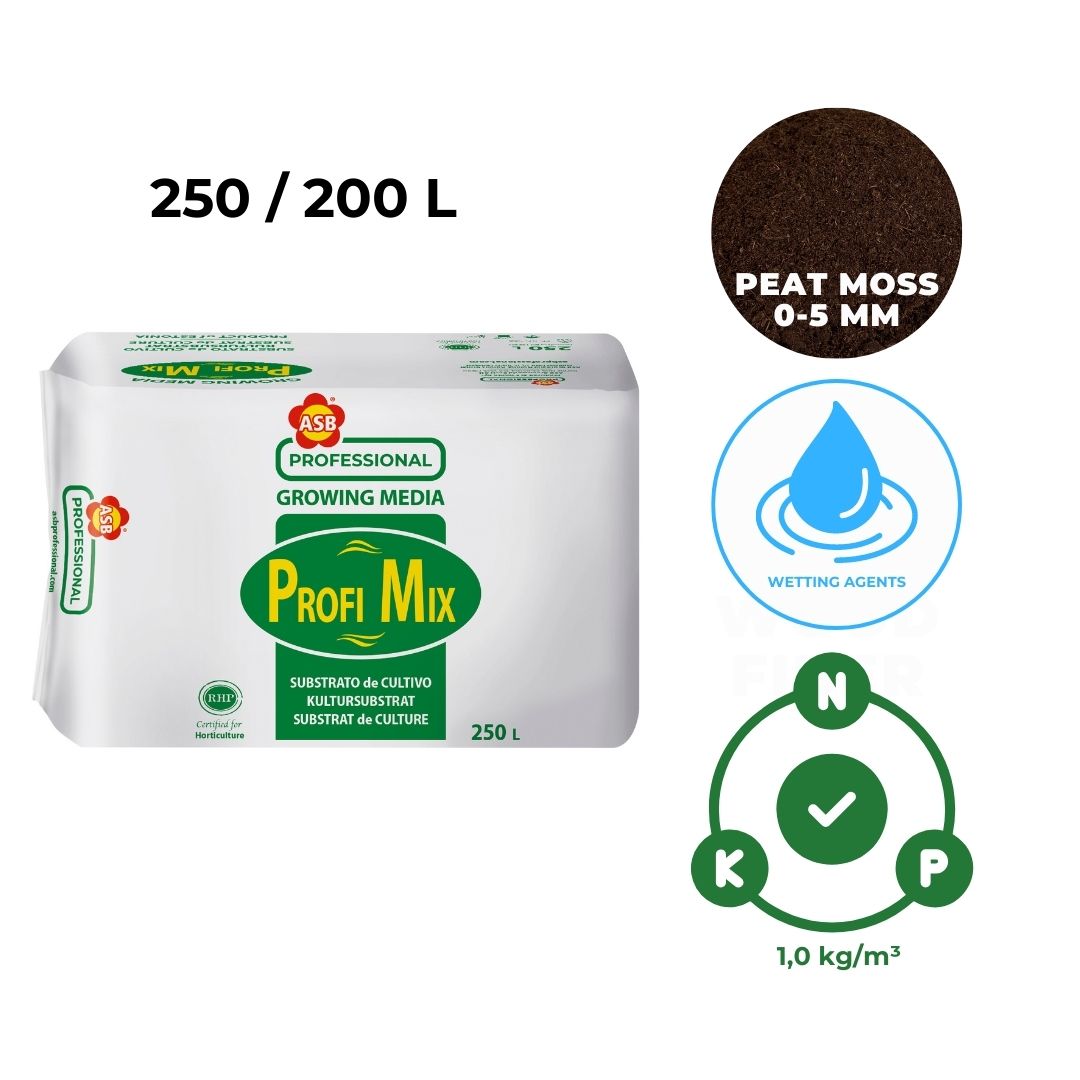
ASB Professional Substrate 0-5 WA NPK
A finished propagation example where pH, EC, irrigation and starter nutrition need to be assessed together in small tray cells.
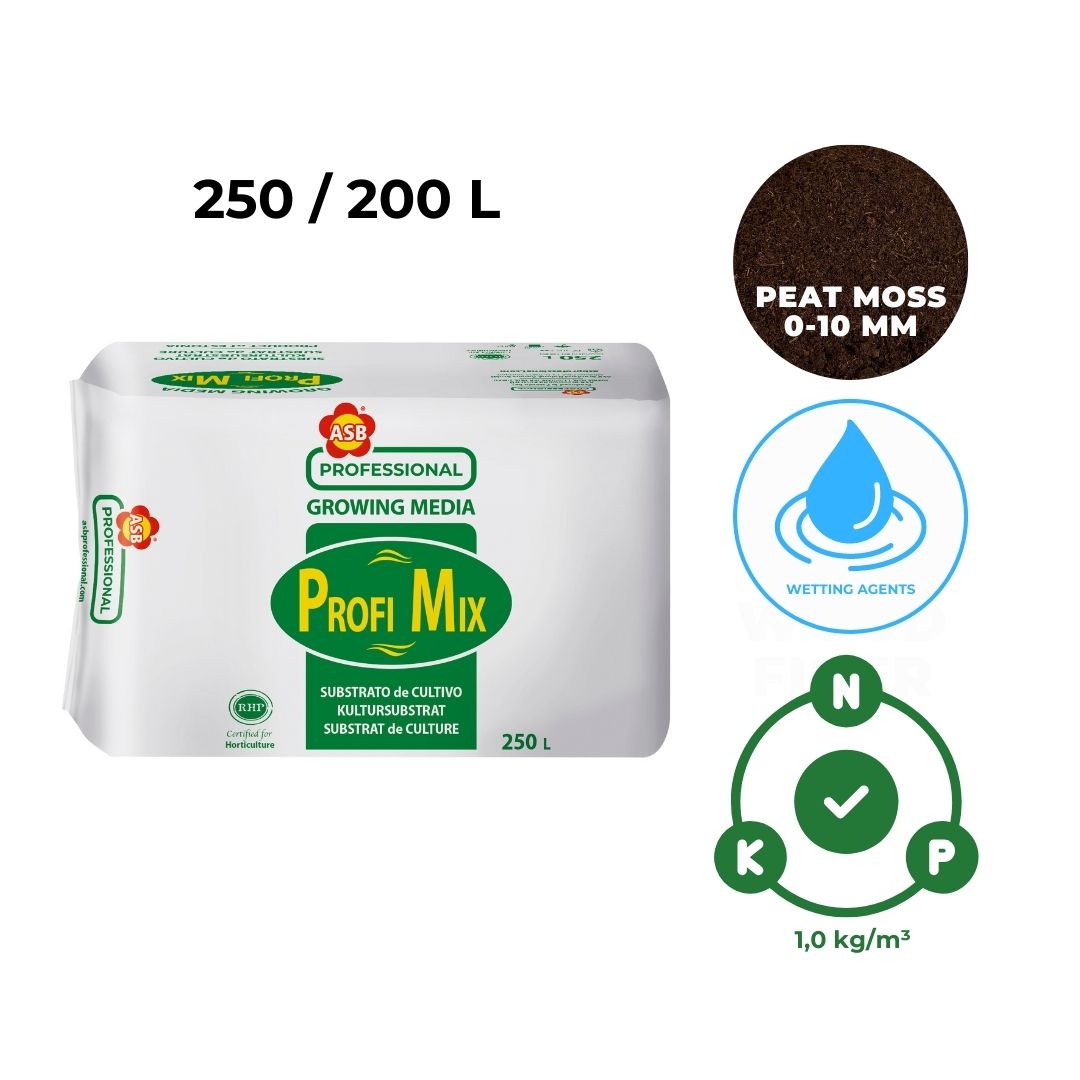
ASB Professional Substrate 0-10 Fertilizer
A finished young-plant substrate reference for comparing product documentation with a real nursery trial.
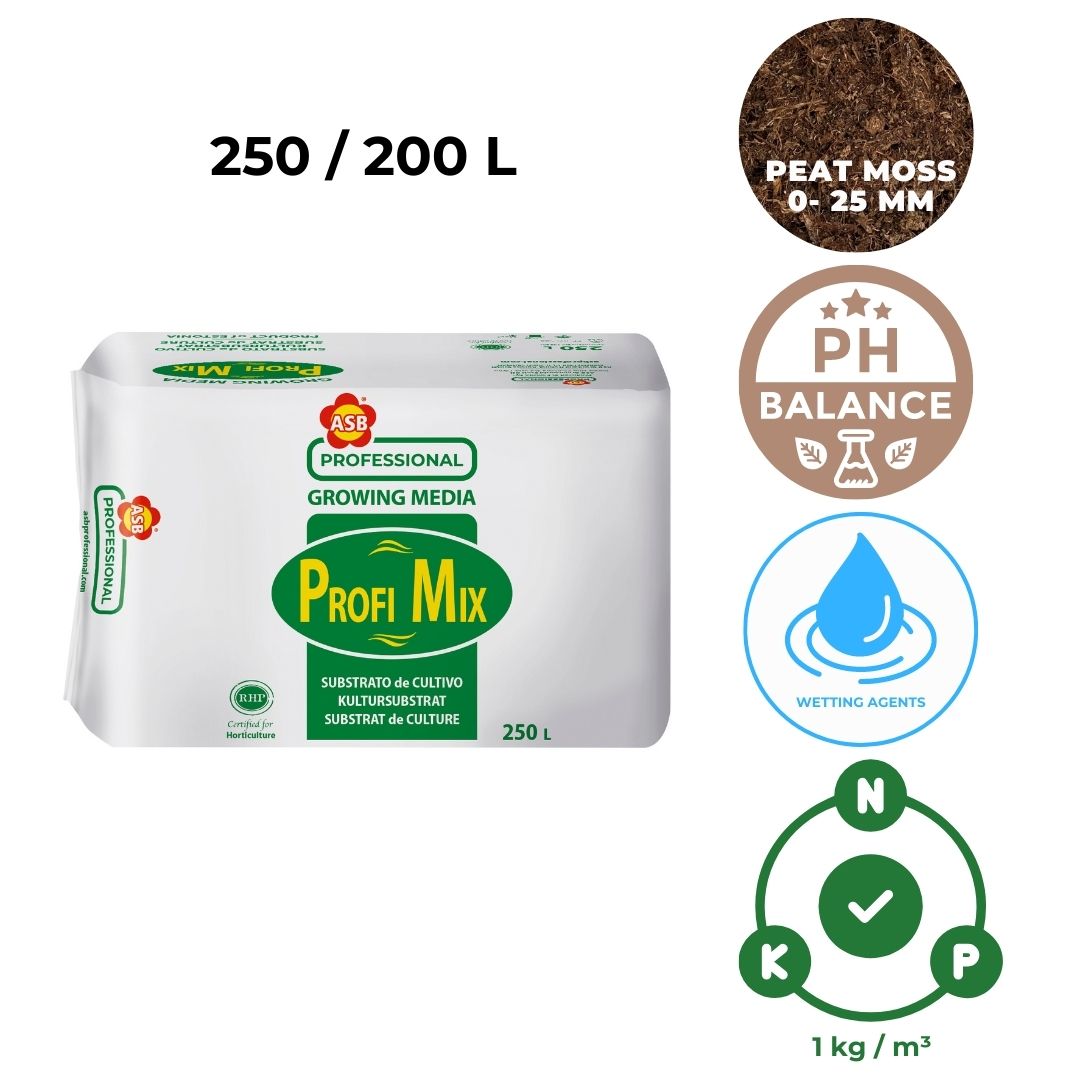
ASB Professional Substrate Mix 0-25 NPK
A wider finished-growing-medium reference where crop stage, fertilizer programme and root-zone monitoring must work together.
Make pH and EC data comparable before using it
| Criteria | What to request | Why it matters |
|---|---|---|
| pH method and sample condition | State whether the result comes from a saturated media extract, dilution method, leachate method or another agreed procedure, plus the sample condition. | Different extraction procedures can produce different values from the same growing medium. |
| EC method and unit | Confirm the extraction method and report the EC unit, for example mS/cm, together with the result. | EC is a measurement of the extracted solution. A number without its method and unit is incomplete commercial information. |
| Product level | Confirm whether the sample is raw peat, a base material, or a finished peat-based growing medium with liming, fertilizer or wetting agent. | Formulation changes the starting pH and soluble-salt picture, so raw material and finished substrate results should not be compared as if they were equivalent. |
| Water and fertilizer context | Provide an irrigation-water analysis, alkalinity result and fertilizer plan for the intended crop programme. | These operational inputs can shift root-zone pH and EC after planting, even when the starting product is consistent. |
FAQ
What do pH and EC mean in peat moss growing media?
pH describes the acidity or basicity of the measured substrate solution. EC, or electrical conductivity, indicates the concentration of dissolved salts in that solution. Both are useful indicators, but they must be read with the test method, product formulation and crop context.
Why can two laboratories report different pH or EC values for similar growing media?
Growing-media laboratories can use different extraction procedures, dilution ratios, sample preparation steps and units. Those differences can change the result. Buyers should compare values only when the method and reporting basis are the same or have been interpreted by a qualified technical team.
Is a lower EC always better in a peat substrate?
No. EC needs to fit the crop stage, starting nutrition, irrigation strategy and fertilizer programme. A raw peat material and a finished fertilized growing medium can have different expected EC readings because they are different product types.
Why is irrigation-water alkalinity important for substrate pH?
Alkalinity reflects the water’s capacity to neutralize acids. It can move substrate pH over time, especially in container production, so it should be evaluated separately from water pH.
What should a commercial buyer request with a peat moss pH and EC report?
Request the sample identity and date, product formulation, pH and EC method, EC unit, moisture or sample condition, relevant physical specifications, irrigation-water analysis, intended crop use and a realistic trial plan.
Why must the extraction liquid and ratio be stated with a pH or EC result?
Results can differ when a laboratory measures in water (H2O) rather than sodium chloride (NaCl), or uses a different extraction ratio such as 1:5 or 1:1.5. Values are more comparable when the same agreed standard, extraction liquid, ratio, unit and sample condition are used.
Can EC results be converted between saturated media extract, PourThru and 1:2 dilution?
No universal conversion factor should be used for a purchasing decision. Each method prepares and extracts the sample differently, so results should be compared using the same method or interpreted by a qualified technical adviser.
Need to review pH and EC data for a crop programme?
Share the crop, tray or container, irrigation-water analysis, fertilizer programme, target volume and the product data available. The ASB Professional team can help structure the technical discussion before a trial or larger order.
This article is part of the ASB Professional Blog and highlights topics across events, sustainability, and technical growing media expertise. ASB Greenworld Eesti is listed as a member of the Estonian Peat Association (Eesti Turbaliit).
It helps customers and partners follow company developments, market activity, and product-related topics.
ASB Professional Editorial Team