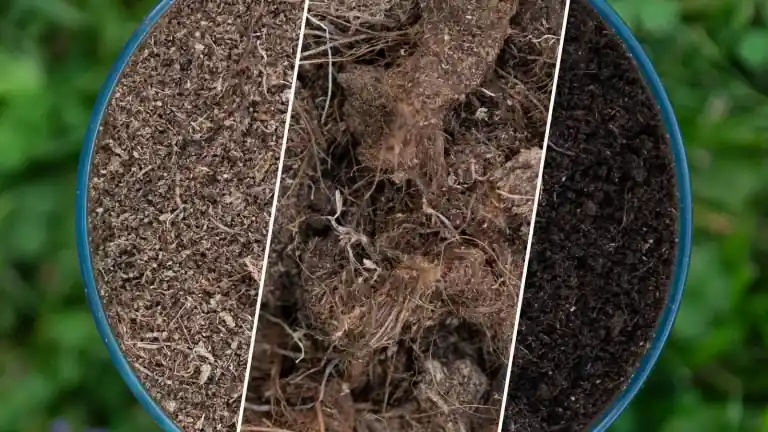
White peat is generally less decomposed and more fibrous, brown peat is an informal intermediate category, and black peat is generally more decomposed and finer. Professional buyers should use those descriptions as a starting point, then compare measured structure, water-air properties, processing and trial results for the real crop system.
- White, brown and black peat are broad commercial descriptions, not universal grades.
- Decomposition and colour are relevant, but fraction, processing and packing can change physical behaviour substantially.
- The right peat direction depends on the crop, container, irrigation, recipe and production period.
- Laboratory data should be followed by a realistic production trial before larger volumes are committed.
A colour name is only the starting point
These are general material directions. The final root-zone result depends on the complete specification, not the visual colour alone.
White peat
- Decomposition
- Usually weakly decomposed; often associated with lower von Post values.
- Visible structure
- Often visibly fibrous, with a higher proportion of larger pores when the fraction is coarse.
- Root-zone discussion
- Confirm air capacity, water distribution and filling density for the intended container.
Brown peat
- Decomposition
- An intermediate commercial description whose exact range varies.
- Visible structure
- Partly decomposed and transitional; the visible colour is not a standardised specification.
- Root-zone discussion
- Request actual fraction, decomposition range and physical data before comparing offers.
Black peat
- Decomposition
- Usually more strongly decomposed, with fewer recognisable plant structures.
- Visible structure
- Often finer and denser than weakly decomposed peat, depending on processing and fraction.
- Root-zone discussion
- Check total versus available water, aeration, rewetting and recipe suitability.
Commercial colour terms and decomposition ranges vary between suppliers. Confirm the complete product specification before making a production decision.
White peat vs black peat is often presented as a simple colour comparison. For professional growing media, that is too limited. White, brown and black peat are useful commercial descriptions, but they do not replace a product specification or a crop trial.
A buyer selecting peat for growing media needs to know how the material will behave in the actual production system: during filling, first wetting, irrigation, drainage, dry-down and root development. That behaviour is affected by decomposition, botanical origin, particle-size distribution, processing, moisture history and packing as well as colour.
The practical starting point:
White peat, brown peat and black peat should be treated as descriptions of a material direction. They are not three universal quality levels and they are not interchangeable product names.
A reliable comparison starts by asking what evidence is available beyond the colour label: decomposition range, fraction, bulk density, air and water properties, pH and EC method, moisture at delivery, consistency, packaging and trial performance.
What the colour terms usually mean:
White peat is commonly used for weakly decomposed, visibly fibrous peat. It is often associated with lower values on the von Post decomposition scale and a higher proportion of larger pores when compared with finer, more decomposed material.
Brown peat is usually an informal term for an intermediate level of decomposition. It is the least standardised of the three descriptions. One supplier’s brown peat may not have the same decomposition range, fraction or physical behaviour as another supplier’s material.
Black peat is commonly used for more strongly decomposed, darker peat with fewer recognisable plant structures. It is often finer and denser than weakly decomposed fibrous peat, but its final behaviour still depends on origin, processing and fraction.
This is why colour is a useful first conversation, not the final purchasing criterion.
Why decomposition changes growing-media behaviour:
Peat forms when plant material accumulates in waterlogged conditions and decomposes slowly. As decomposition progresses, recognisable plant tissues are reduced and the pore system changes. In broad terms, more decomposed peat tends to have smaller particles, greater bulk density and fewer large pores than weakly decomposed fibrous peat.
This affects how the material fills a tray or pot, how water moves through it and how much air remains around roots after irrigation. It does not mean that all light peat behaves one way or all dark peat behaves another way. Two materials with a similar colour can still have different particle-size distributions, moisture histories and physical results.
The von Post scale provides useful context:
The von Post scale describes peat decomposition from H1 to H10. Lower H values represent less decomposed peat with more recognisable plant structure. Higher values represent more decomposed, amorphous peat.
A simplified commercial interpretation may group lower values with white peat, intermediate values with brown or dark peat, and higher values with black peat. These boundaries are guidance rather than universal legal definitions. The scale is also a field assessment, so it should be combined with laboratory and production data.
For a broader explanation of how peat fraction and components shape a complete recipe, see Peat Substrates for Professional Growing Media. For a direct comparison of the 0-5 to 0-40 mm fraction range, see Compare Peat Moss Fractions.
Fraction and processing can outweigh colour:
Particle-size distribution controls a major part of the root-zone pore system. Finer particles can fill voids and reduce air-filled pore space. Coarser particles can create larger pores that support drainage and aeration. A mixture of fine and coarse fractions can behave differently again because fines may occupy the spaces between larger particles.
The same is true for handling. Drying, compression, storage and filling density can alter the effective structure that reaches the crop. A good technical discussion should therefore include the declared fraction, moisture condition, packing format and how the material will be processed or filled after delivery.
Water retention needs the right question:
It is not enough to ask which peat holds the most water. A professional grower needs to know how much water is available, how easily water moves through the medium, how much air remains after drainage and whether the material can be rewetted after a controlled dry-down.
Container geometry changes the answer. The same growing medium behaves differently in a shallow plug tray and a larger pot because container height, filling density and irrigation frequency change the air-water profile. This is one reason laboratory data should be interpreted together with the real crop system.
Crop use changes the right peat direction:
Seed and plug production often needs uniform filling, close seed or cutting contact, predictable wetting and sufficient oxygen in a small cell. The seed and propagation range is a separate product direction because propagation performance cannot be inferred from colour alone.
Vegetable transplant and container programs need a balance between water supply, drainage and root-zone aeration through the production cycle. The relevant discussion includes irrigation rhythm, water alkalinity, container volume and how long the structure must remain stable. Substrate for Vegetables covers this crop-specific decision in more detail.
Blueberry and other acid-loving crop programs need an acidic root-zone direction, but peat colour alone does not define the final pH, drainage or water-management result. Fraction, liming and fertilizer plan, irrigation-water alkalinity, container size and crop duration need to be evaluated together. Substrate for Blueberries explains this separate crop context.
Blends should be evaluated as complete recipes:
Professional growing media may combine different peat structures with perlite, wood fiber, coir, bark, clay, fertilizer or wetting agents. Each component should have a clear purpose. It may change air capacity, drainage, water distribution, buffering, cohesion, starting nutrition or handling.
The final result is not a simple average of the ingredients. A recipe containing a coarse component may still have limited air capacity if fine material fills the larger pores or if the medium is packed densely. This is why buyers should compare the complete growing medium, not only an ingredient list or a colour description.
What a professional buyer should request:
- the intended use: raw material for local mixing or a finished growing medium
- peat type, origin and declared decomposition range
- fraction or sieve distribution
- moisture at delivery and packaging format
- pH and EC together with the measurement method
- bulk density and available air-water data, where available
- added components, liming, fertilizer and wetting-agent status
- sampling, traceability and consistency information
- required documents, storage guidance and delivery planning
European test methods are commonly used to evaluate growing-media chemical and physical properties. When comparing offers, make sure the results were produced using compatible methods. Numbers from different methods or different moisture conditions may not be directly comparable. Peat Moss pH and EC explains why the extraction method, liquid, ratio, unit and sample condition should accompany every reported result.
A practical trial before larger volumes:
A laboratory report is important, but the commercial test should reproduce the intended production conditions. Use the actual crop, tray or pot, filling method, irrigation water, fertilizer program and production period.
During the trial, record filling behaviour, first wetting, water distribution, dry-down, drainage, root development, crop uniformity, pH and EC direction, shrinkage and the amount of correction required from the growing team.
The decision is not only whether plants survive. The useful question is whether the material supports consistent production without extra irrigation corrections, uneven wetting, avoidable labor or unreliable results between batches.
Common mistakes to avoid:
- treating white, brown or black as fixed quality grades
- comparing raw peat with a finished mix only by price per volume
- assuming a colour label predicts air capacity or plant-available water
- ignoring irrigation water, container height and filling density
- choosing packaging that does not fit storage or the filling line
- scaling up without a realistic trial
For buyers who blend locally, the ASB Professional raw materials range helps separate a raw-material purchase from a finished crop-specific medium. The Worldwide product portfolio provides the wider product context.
Practical conclusion:
White peat, brown peat and black peat are useful technical starting points, but they do not make a complete specification. The strongest buying process defines the crop system first, confirms the material structure and measured properties, checks commercial supply requirements and then validates the result in a realistic trial.
The best peat direction is not automatically the lightest or the darkest material. It is the raw material or finished composition that produces predictable root-zone conditions for the intended crop, container, irrigation routine and production period.
Recommended ASB products
These products are commonly evaluated with the strategy covered in this article.
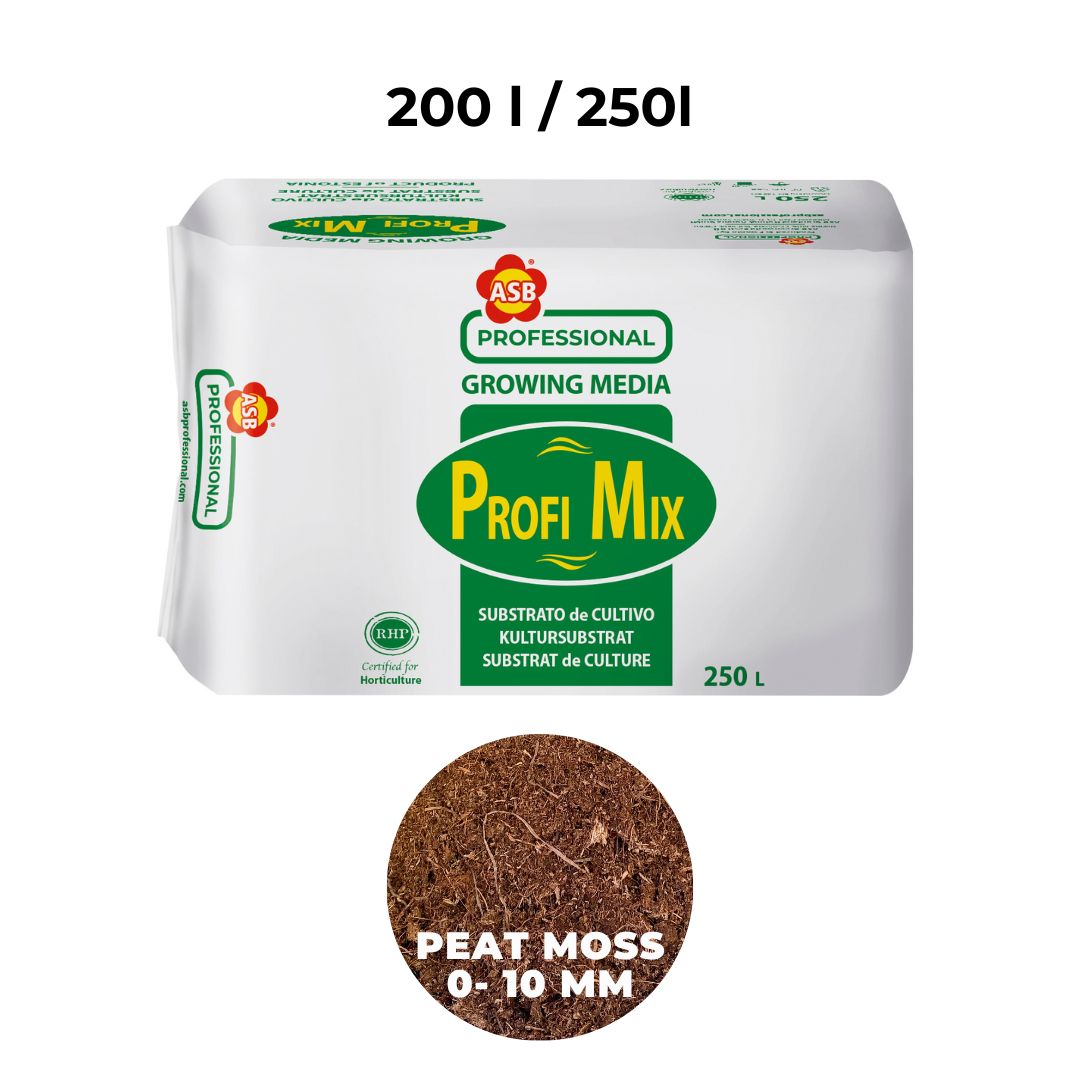
ASB Professional Substrate WP010
For substrate producers and buyers who prepare a local recipe and need to discuss fraction, moisture and intended use.
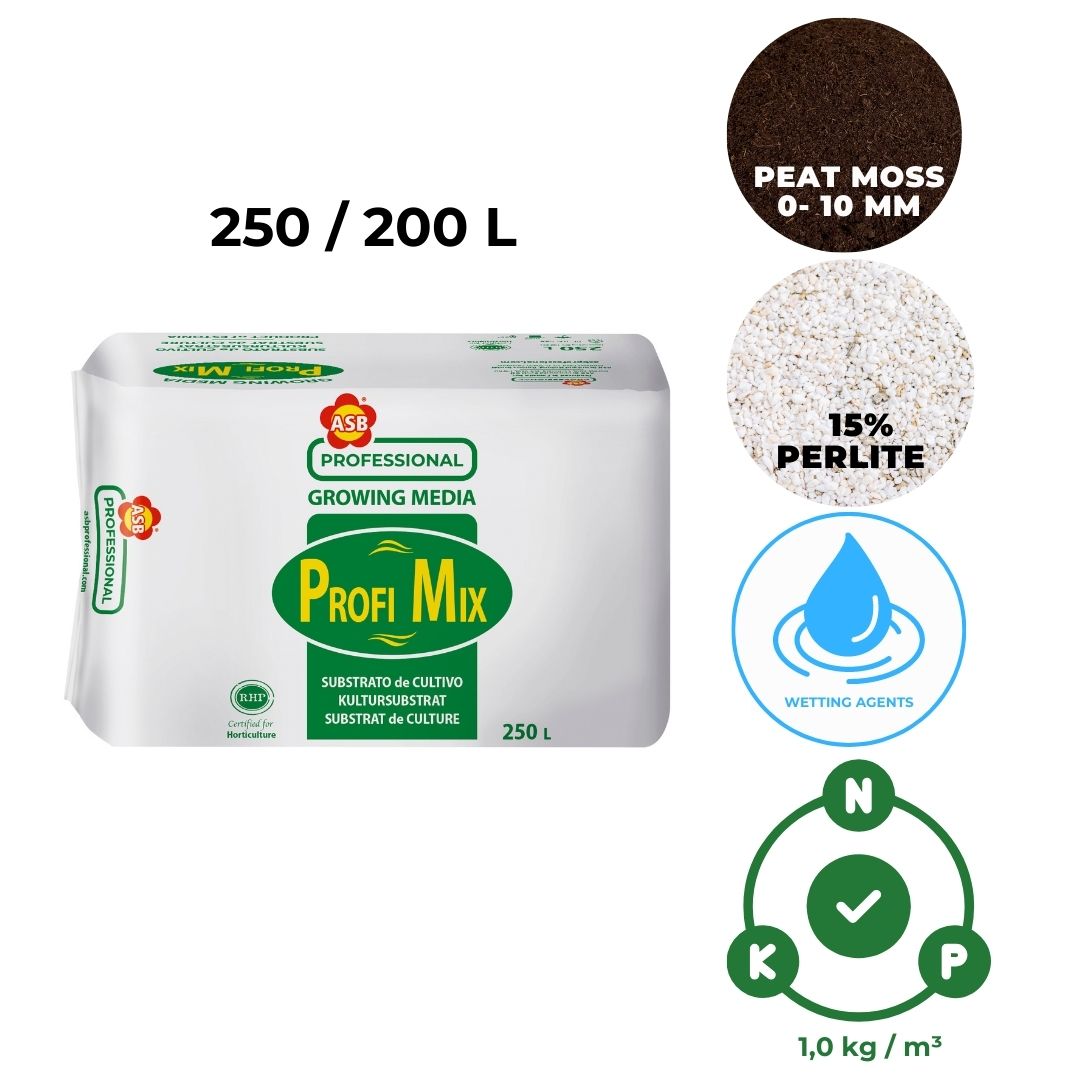
ASB Professional Substrate 0-10 Perlite
For young plant programs where uniform filling, moisture distribution and root-zone air-water balance are central.
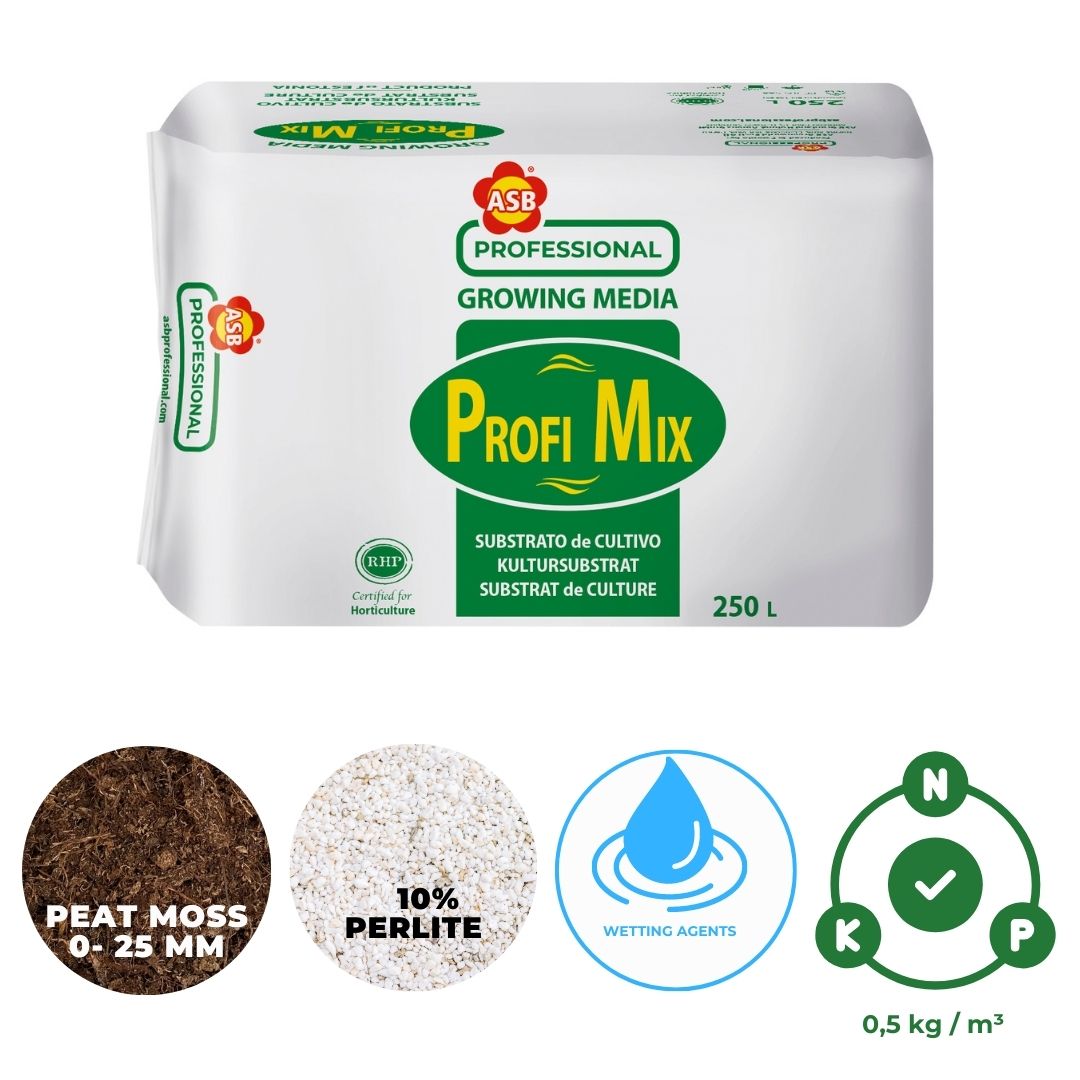
ASB Professional Substrate Mix 0-25 Perlite
For growers comparing a finished growing-medium direction with a raw peat purchase.
White, brown and black peat: general tendencies
| Criteria | Peat description | What a buyer should confirm |
|---|---|---|
| White peat | Usually weakly decomposed and visibly fibrous. | Confirm fraction, air capacity, water behaviour and filling density. |
| Brown peat | An informal intermediate description that varies between suppliers. | Request the actual decomposition range and physical specification. |
| Black peat | Usually more strongly decomposed, darker and finer. | Confirm cohesion, water-air balance, rewetting and crop suitability. |
| Any peat blend | The final mixture does not behave like a simple average of its ingredients. | Evaluate the complete recipe under real container and irrigation conditions. |
FAQ
What is white peat?
White peat is a commercial term usually used for weakly decomposed, visibly fibrous peat. It is often associated with lower von Post values, but the exact commercial definition and specification can vary.
What is brown peat?
Brown peat generally describes an intermediate degree of decomposition. It is not a universal international grade, so buyers should request the supplier’s measured specification rather than rely on the colour name alone.
What is black peat?
Black peat generally describes more strongly decomposed, darker peat with fewer recognisable plant structures and a finer physical character than weakly decomposed peat.
Does black peat always hold more usable water than white peat?
Not necessarily. Total water retention, plant-available water, drainage and air capacity depend on pore distribution, fraction, packing and container conditions. Colour alone is not enough to predict performance.
What does the von Post scale mean?
The von Post scale describes peat decomposition from H1 to H10. Lower values represent less decomposed material with more recognisable plant structure, while higher values represent more decomposed material.
Should peat be trialled before a large order?
Yes. A useful trial should use the actual crop, tray or pot, filling method, irrigation water, fertilizer program and production period before a larger commercial volume is confirmed.
Need help comparing peat structure for a crop program?
Share the crop, container, irrigation method, intended recipe or direct-use requirement, expected volume and destination so the ASB Professional team can discuss an appropriate product direction.
This article is part of the ASB Professional Blog and highlights topics across events, sustainability, and technical growing media expertise. ASB Greenworld Eesti is listed as a member of the Estonian Peat Association (Eesti Turbaliit).
It helps customers and partners follow company developments, market activity, and product-related topics.
ASB Professional Editorial Team