Choose growing media for bedding plants around the finishing pot, the incoming plug and the irrigation system. A mix that fills a small propagation cell well still needs to be assessed for the next container. The useful test is whether roots establish in the new medium and the crop reaches a consistent, saleable stage under the grower's production conditions.
- Choose the mix for the finishing pot, incoming plug and irrigation system.
- Inspect plugs on arrival so existing problems are not attributed to the new mix.
- Check moisture in the original plug as well as the surrounding medium after potting.
- Compare plants at the sale stage, including uniformity, rejects and extra watering.
A tray of rooted plugs arrives with much of the early work already done. The next job is to move those plants into their selling format without losing that uniformity. This guide covers the move into finishing pots for flowering bedding plants, rather than seed germination or planting finished flowers into a garden.
Start with the pot you intend to sell
Before comparing mixes, put an empty finishing pot beside the incoming plug tray. Note the pot volume and depth, the number of plugs per pot and the planned sale date. Those details give the substrate supplier a clearer brief than the plant name alone.
A small individual pot and a hanging basket are different production jobs, even when both contain flowering plants. UConn Extension identifies container size, cultivar and growing conditions among the factors affecting bedding-plant finishing time. The substrate choice belongs in that production plan.
Use the actual pot in a trial. A result from a convenient spare container tells the filling and irrigation teams little about the crop they will be running.
Inspect the plug before changing the mix
Check incoming plants before they reach the transplanting station. Look for an intact root ball, variation in plant size, dry tray edges and visible pest or disease concerns. Keep the supplier reference with the batch. UMass Extension recommends inspecting plugs on arrival and reporting problems to the supplier promptly.
If the tray already contains uneven plants, photograph them at the start. Otherwise, differences noticed a week later can easily be attributed to the new growing medium even though they were present before potting.
For growers producing their own plugs, the seedling-mix decision is covered separately in How to Choose Seedling Mixes for Uniform Germination. Here, the starting material is a rooted young plant ready for the next stage.
Choose a finishing mix, not a fraction in isolation
The mix must fill around the root ball, hold the plant securely and support water management in the finishing container. Peat fraction is one part of that choice. The complete blend also depends on peat type and degree of decomposition, any added components such as perlite, the wetting agent and fertiliser charge, and how densely the mix is filled. The peat-fractions guide explains what the size ranges describe.
Texas A&M Extension distinguishes the role of a propagation medium from that of a potting medium that supports further plant growth. A grower does not always have to change recipes at transplanting, but the recipe needs to suit the finishing stage, whether the same mix is retained or a different one is selected.
For a peat-based potting mix, compare how it runs through the intended filling equipment and how it surrounds the plug without leaving large gaps. Check filling consistency across a whole run, not just the best-looking pot. Avoid choosing a coarser mix simply because the plant has moved into a larger container.
Match the pH to the crop
Flowering crops do not all need the same root-zone pH. Purdue Extension groups common bedding crops as follows:
- Petunia group, including petunia, calibrachoa and pansy: pH 5.4–6.2.
- General group, including ivy geranium and impatiens: pH 5.8–6.4.
- Geranium group, including seed and zonal geranium and marigold: pH 6.0–6.6.
Choose a starting pH that suits the crop group, then manage it with the irrigation water and feeding programme, monitoring the root zone with a consistent method. For the effect of water during production, see irrigation water alkalinity and growing media pH.
Two ASB potting mixes for a finishing trial
ASB Professional produces its potting mixes in Estonia under RHP certification. Two formulations are a practical starting point for a bedding-plant trial.
ASB Professional Substrate Mix 0-25 NPK combines a 0–25 mm peat structure with a 1 kg/m³ NPK 15-10-20 starter fertiliser at pH 5.8–6.2. It suits growers who want a full starter charge in the pot at transplanting.
ASB Professional Substrate Mix 0-25 Perlite adds 10% perlite to the same 0–25 mm peat structure for extra air space and drainage, with a lighter 0.5 kg/m³ starter charge for growers who prefer to take control of feeding early.
Both mixes contain a wetting agent, which helps the finishing mix take up water evenly and re-wet around the plug. pH can be adjusted to order for petunia-group or geranium-group crops. Choose the trial formulation using the cultivar, plug size and finishing pot, and the ASB team will confirm the current specification for your order. The peat-and-perlite guide explains when the added component is most useful.
Transplanting plugs without compressing the mix
Prepare the mix according to the product instructions and fill pots consistently. UMass Extension recommends pre-moistened medium, light filling and avoiding compression from tamping or nesting filled pots. It also advises gentle handling and avoiding planting plugs too deeply.
Watch a short run at the transplanting station. Does each root ball sit at a consistent depth? Is the plant stable? Are workers correcting the fill by pressing some pots harder than others? A change in filling practice can undermine a comparison between two mixes.
Check the original plug as well as the new medium
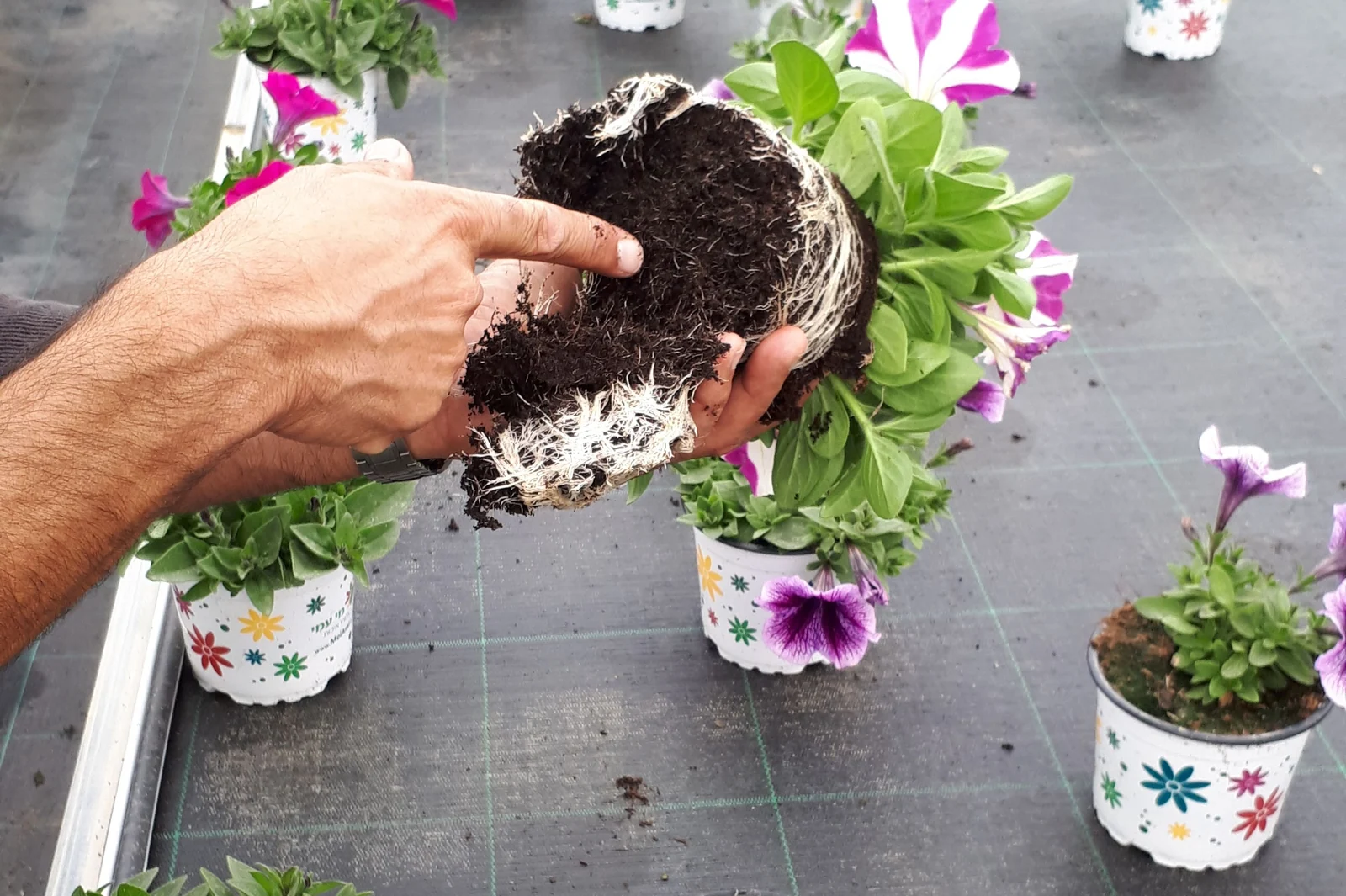
After potting, inspect both the original root ball and the surrounding growing medium. Check moisture at each location during the first irrigation cycles instead of relying only on the surface appearance of the whole pot.
UMass notes that young plants from different suppliers can arrive in different growing media and that watering practices need to account for this. A change of young-plant supplier may change the starting condition even when the finishing mix stays the same.
During inspection, ease a few plants from their pots and look for roots extending into the surrounding medium. If the plug is dry while the surrounding mix is moist, check water delivery and contact around the root ball before simply watering the whole pot more often.
Compare the crop at the sale stage
Agree on the trial criteria before transplanting. Keep one short record for each comparison rather than separate notes that cannot be matched later.
- At arrival: plug supplier, batch and any uneven or damaged plants.
- At potting: date, substrate batch, container and filling adjustments.
- During establishment: moisture in the plug and new medium, roots growing beyond the plug, and extra watering or handling.
- At sale: date ready, plant-size uniformity, rejects and plants needing more growing time.
Keep the cultivar, plug source, container and production area comparable. If one group needs a different irrigation approach, record the change and the labour involved. The result should show how the mix fits a working programme, not just how plants look in a single photograph.
Root establishment is an early checkpoint. Continue the comparison to the intended sale stage. UConn Extension stresses that weather, temperature, light, plant health and nutrition also affect finishing time, so record them alongside the substrate.
A practical comparison in 10.5 cm pots
Consider a grower moving one cultivar of rooted flowering plugs into 10.5 cm pots. The question is whether a candidate mix reduces uneven establishment and extra hand watering compared with the current mix.
Use plugs from the same delivery, the same pot and a consistent filling method. Place several small groups of each mix across comparable positions, rather than giving one mix the sunny edge and the other a shaded bench. Start with the same irrigation approach and note any changes needed for either group.
During establishment, compare moisture inside and outside the original plug and look for roots entering the new medium. At the planned sale stage, compare how many plants are ready together and how much additional watering or sorting each group required. A mix that needs fewer corrections is worth more than one that simply produces the best single plant.
In short
Choose the finishing mix around the pot, plug and irrigation system, not the fraction alone. Match the starting pH to the crop group, and inspect plugs on arrival so the comparison starts fairly. Judge the result at the sale stage, by uniformity, rejects and labour, not by a single photograph.
What to send ASB before the next potting run
Include these details in the enquiry:
- Crop and cultivar, with a photograph if helpful.
- Plug supplier, tray format and condition on arrival.
- Finishing pot volume, depth and plugs per pot.
- Planned potting date and target sale window.
- Filling method, irrigation system and current feeding programme.
- Current mix and the specific problem the trial should address.
Explore ASB Professional's potting mixes and send the team a brief for your next crop. The aim is even establishment after transplanting, manageable watering and consistent plants ready for sale.
Recommended ASB products
These products are commonly evaluated with the strategy covered in this article.
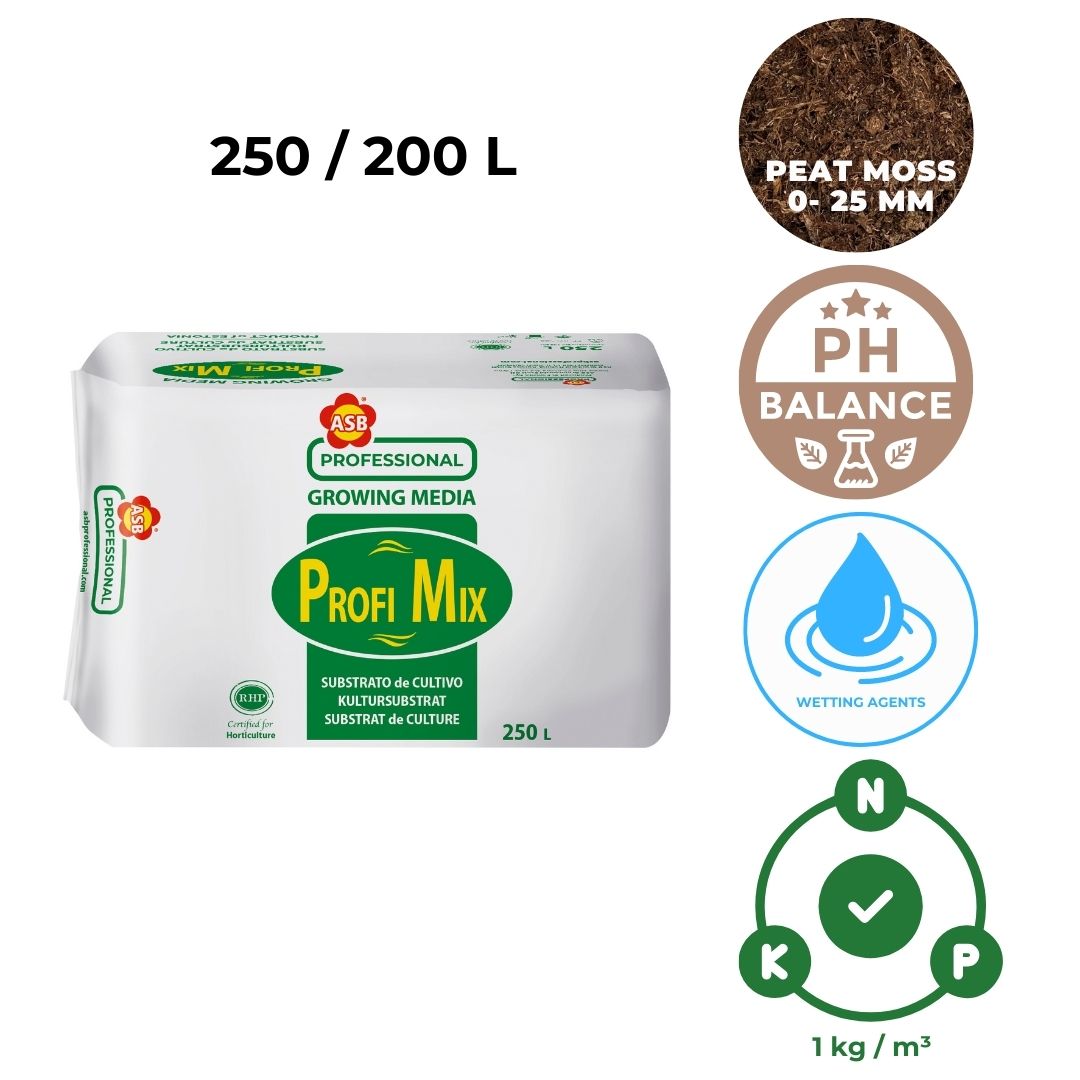
ASB Professional Substrate Mix 0-25 NPK
0–25 mm peat with 1 kg/m³ NPK 15-10-20, a wetting agent and pH 5.8–6.2. The starting pH can be adjusted to order.
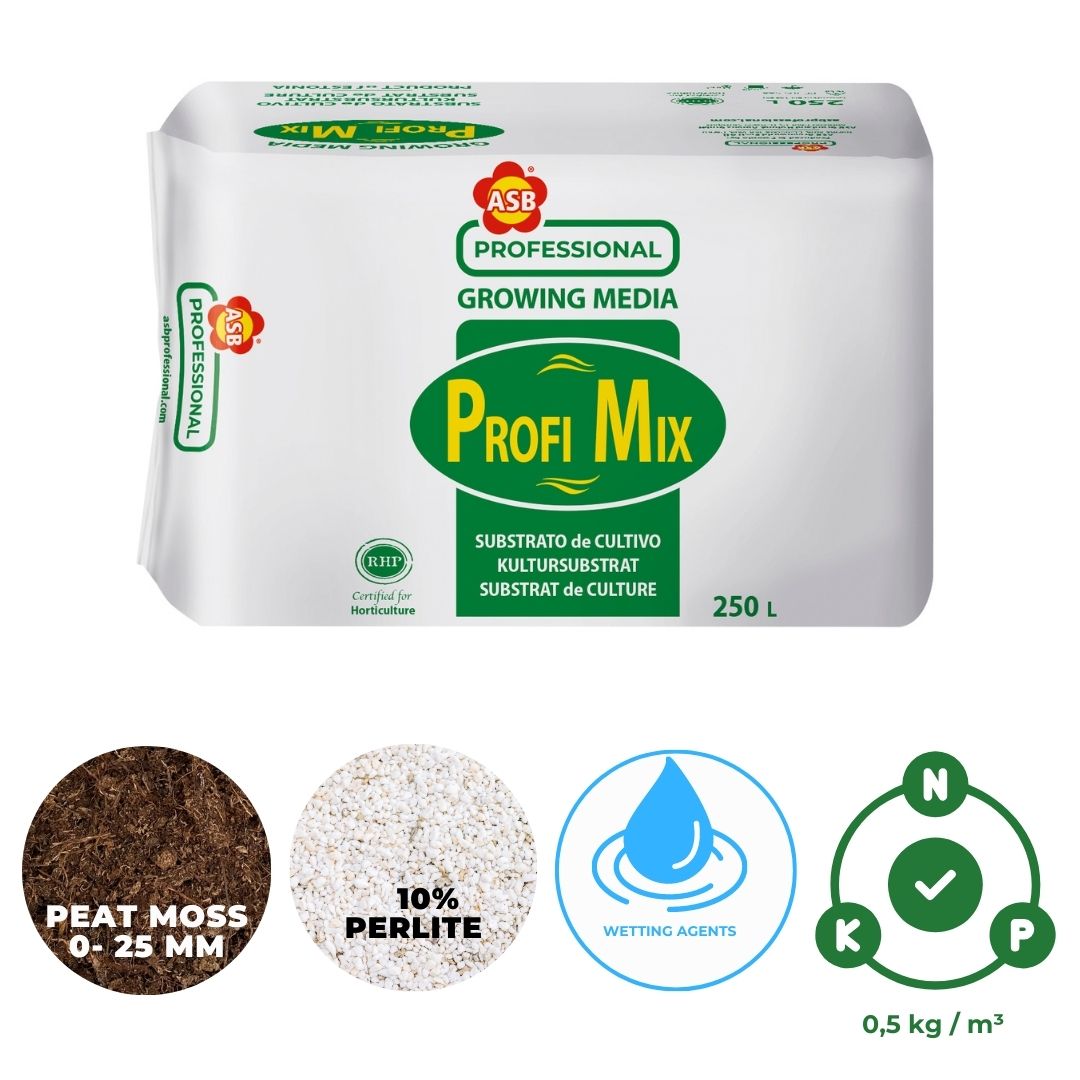
ASB Professional Substrate Mix 0-25 Perlite
0–25 mm peat with 10% perlite, a wetting agent and a 0.5 kg/m³ starter charge. Discuss the crop and feeding programme with ASB.
FAQ
Can I use the same growing medium for plugs and finishing pots?
Sometimes. A mix used in small propagation cells may also work in finishing pots, but test it in the intended container. Check how it fills around the plug, how moisture is distributed and how roots establish before using it for a full crop.
How deep should plugs be planted when transplanting?
Keep the original plug surface level with the surrounding growing medium. Avoid burying the stem or pressing the mix down firmly around it. Follow any crop-specific planting instructions supplied with the young plants.
Why can the plug be dry while the surrounding mix looks moist?
The original plug and the finishing mix can differ in how they take up and hold water. Check moisture inside the plug separately, then inspect water delivery and contact between the root ball and the new medium. A wet pot surface does not show the moisture throughout the pot.
What pH do bedding plants need?
The target depends on the crop. Purdue Extension lists root-zone pH 5.4–6.2 for the petunia group (petunia, calibrachoa, pansy), 5.8–6.4 for the general group (including ivy geranium and impatiens) and 6.0–6.6 for the geranium group (seed and zonal geranium, marigold).
When should liquid feeding start after transplanting plugs?
Set the feeding start with the crop, the starter fertiliser charge and the feeding programme, rather than a fixed number of days after potting. Use root-zone EC measurements and crop observations to decide when to begin, and ask the ASB team for guidance on the mix you are trialling.
How do I know whether a new finishing mix works?
Compare it with the current mix using the same cultivar, plug source, pot and comparable production conditions. Follow root establishment, then compare plants ready together, size uniformity, rejects and extra labour at the sale stage. A single photograph or the best plant in each group is not enough.
Choosing a mix for your next potting run?
Share the crop, plug format, finishing pot, irrigation system and sale window to discuss potting mixes produced in Estonia with the ASB Professional team.
ASB Professional Editorial Team